
Introduction
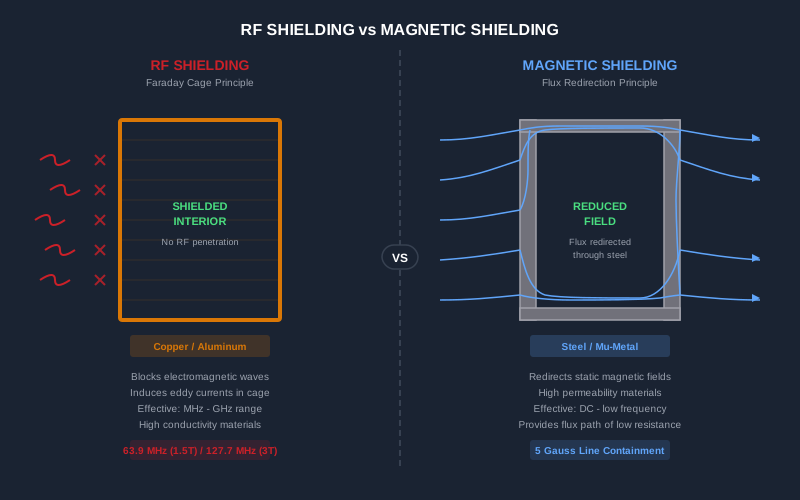
MRI installations require two fundamentally different types of shielding, each addressing a distinct physical phenomenon. RF (radiofrequency) shielding blocks high-frequency electromagnetic waves in the MHz range, while magnetic shielding contains the powerful static magnetic field generated by the MRI magnet. Confusing the two — or neglecting one — is a common and costly mistake in MRI room construction.
Every MRI installation requires RF shielding in the form of a Faraday cage. Magnetic shielding, however, is only required when the magnet's fringe field extends beyond the acceptable controlled area. Understanding when each type is needed — and how they work together — is essential for planning a compliant, cost-effective MRI suite.
What Is RF Shielding?
RF shielding, implemented as a Faraday cage, blocks radiofrequency electromagnetic waves from entering or leaving the MRI scan room. It operates on the principle of electromagnetic induction: when an RF wave encounters the conductive enclosure, it induces currents in the conductor that generate an opposing field, effectively canceling the wave inside the enclosure.
Why RF Shielding Is Always Required
MRI scanners both emit and receive RF signals as part of the imaging process. The RF transmit coil excites hydrogen atoms at the Larmor frequency (63.87 MHz for 1.5T, 127.74 MHz for 3T), and the receive coil detects the faint return signal from the patient's tissues. This return signal is extremely weak — on the order of microvolts — making it highly susceptible to external RF interference.
Without an RF-shielded enclosure, ambient RF energy from cell phones, Wi-Fi, broadcast radio, and other sources would overwhelm the MRI signal, producing unusable images. Simultaneously, the scanner's own RF emissions could interfere with nearby medical equipment.
Materials for RF Shielding
RF shielding effectiveness depends on the material's electrical conductivity. Copper and aluminum are the standard choices for MRI Faraday cages. Both are non-ferromagnetic (critical for use near MRI magnets) and provide excellent RF attenuation. A typical MRI Faraday cage achieves 80–100+ dB of shielding effectiveness at the operating frequency.
Frequency Range
RF shielding for MRI targets the radiofrequency spectrum, typically from 10 MHz to 300+ MHz. The primary concern is the Larmor frequency of the installed MRI system, but broadband attenuation across a range of frequencies is required to protect against all potential interference sources.
What Is Magnetic Shielding?
Magnetic shielding contains the MRI magnet's static magnetic field — a DC (zero-frequency) field measured in Tesla. Unlike RF shielding, which blocks oscillating electromagnetic waves, magnetic shielding redirects static magnetic field lines through a high-permeability ferromagnetic material, confining the field to a smaller area around the magnet.
When Magnetic Shielding Is Needed
Modern superconducting MRI magnets incorporate active shielding — secondary coils within the magnet that partially cancel the external fringe field. This significantly reduces the 5-gauss (0.5 mT) footprint compared to older unshielded magnet designs. However, additional passive magnetic shielding may be required when:
- The MRI room is adjacent to public corridors, waiting areas, or offices where the 5-gauss line cannot extend
- Sensitive equipment (electron microscopes, CT scanners, cardiac catheterization labs) is located nearby
- The available room dimensions cannot accommodate the full fringe field footprint of the magnet
- Local regulations or facility policies require stricter field containment than the magnet's active shielding provides
Materials for Magnetic Shielding
Magnetic shielding uses ferromagnetic materials — primarily low-carbon steel plates — because of their high magnetic permeability. The steel provides a low-reluctance path for the magnetic field lines, redirecting them through the steel rather than allowing them to extend into adjacent spaces. This is the exact opposite of RF shielding materials: copper and aluminum are excellent RF shields but completely transparent to static magnetic fields, while steel is an excellent magnetic shield but a poor RF shield.
Typical Implementation
Passive magnetic shielding is installed as steel plates (typically 6–25 mm / 0.25–1 inch thick) on the walls, floor, and/or ceiling of the MRI room — on the outside of the RF Faraday cage. The required steel thickness and coverage depend on the magnet's unshielded fringe field, the distance to controlled boundaries, and the target field reduction. Finite element analysis (FEA) modeling is used to design the optimal steel configuration.
Key Differences at a Glance
| Characteristic | RF Shielding (Faraday Cage) | Magnetic Shielding |
|---|---|---|
| What it blocks | Radiofrequency electromagnetic waves (MHz range) | Static (DC) magnetic field |
| Physical principle | Electromagnetic induction — conductive enclosure cancels internal RF field | High-permeability path — redirects magnetic field lines through ferromagnetic material |
| Materials | Copper, aluminum (non-ferromagnetic conductors) | Low-carbon steel plates (ferromagnetic material) |
| Required for MRI? | Always required — every MRI installation | Only when fringe field extends beyond acceptable boundaries |
| Performance metric | Shielding Effectiveness in dB (e.g., 100 dB = 100,000× attenuation) | Field reduction factor or 5-gauss line displacement in meters |
| Testing standard | IEEE 299, ASTM E1851 | Gaussmeter survey after installation |
| Position relative to each other | Inner layer (closer to MRI scanner) | Outer layer (outside the Faraday cage) |
| Weight impact | Moderate (copper/aluminum panels) | Significant (steel plates add 500–5,000+ lbs) |
How RF and Magnetic Shielding Work Together
When both types of shielding are required, the installation is a layered system. The magnetic shielding (steel) forms the outer layer, installed on the room's structural walls, floor, and ceiling. The RF shielding (Faraday cage) is then installed inside the magnetic shielding, creating a continuous conductive enclosure within the steel shell.
Installation Sequence
The magnetic shielding steel must be installed first during the construction sequence. It is structural in nature and must be anchored to the building's structural elements. The RF shielding panels are then installed inside the steel shell. The two systems must be electrically isolated from each other — a direct electrical connection between the steel and the copper/aluminum Faraday cage could create ground loops that compromise RF shielding performance.
Combined Design Considerations
The combined weight of both shielding systems can be substantial. Magnetic shielding steel alone can add 5,000 to 20,000+ lbs to the room, on top of the RF shielding enclosure weight. This combined load must be factored into the structural engineering from the earliest design phase. Additionally, the total wall thickness increases significantly (50–100+ mm of steel plus the RF shielding panel system), which must be accounted for in the room dimension planning.
Cost Considerations
RF shielding is a fixed cost on every MRI project — it cannot be eliminated. The cost varies based on room size, shielding material, and required SE level, but it is a predictable line item.
Magnetic shielding, when required, can add significant cost due to the volume of steel needed and the structural reinforcement to support it. Strategies to minimize or avoid magnetic shielding costs include:
- Choosing an actively shielded magnet — modern actively shielded MRI systems have dramatically smaller fringe field footprints than older models
- Optimizing room location — placing the MRI room at the building perimeter, on a ground floor, or in a basement reduces the number of directions requiring field containment
- Using distance — the magnetic field drops rapidly with distance (approximately as the cube of distance); adding even 1–2 meters of buffer space can eliminate the need for passive shielding
- Selective shielding — applying steel only to the specific walls or surfaces where the fringe field is problematic, rather than the entire room, based on FEA modeling results
Frequently Asked Questions
Does every MRI room need both RF and magnetic shielding?
Every MRI room needs RF shielding (a Faraday cage) — this is non-negotiable. Magnetic shielding is only needed when the magnet's static fringe field extends beyond the available controlled space. With modern actively shielded magnets and adequate room dimensions, many MRI installations do not require additional passive magnetic shielding.
Can copper or aluminum block the MRI magnetic field?
No. Copper and aluminum are non-ferromagnetic and have no effect on static magnetic fields. They are excellent RF shields but completely transparent to the MRI magnet's DC field. Containing the static magnetic field requires ferromagnetic materials, primarily low-carbon steel plates.
What is the 5-gauss line and why does it matter?
The 5-gauss (0.5 mT) line marks the boundary around an MRI magnet beyond which the static magnetic field is considered safe for the general public and most electronic equipment. It is the standard safety perimeter defined by MRI manufacturers and regulatory guidelines. The 5-gauss line must not extend into uncontrolled public areas such as hallways, adjacent offices, or parking garages.
How thick are magnetic shielding steel plates?
Magnetic shielding steel plates for MRI rooms typically range from 6 mm (1/4 inch) to 25 mm (1 inch) thick, depending on the magnet's field strength, fringe field characteristics, distance to controlled boundaries, and the required field reduction. The exact thickness and coverage are determined through finite element analysis (FEA) modeling specific to each installation.
Which is installed first — RF or magnetic shielding?
Magnetic shielding (steel plates) is installed first, as it is a structural element attached to the building's walls, floor, and ceiling. The RF shielding (Faraday cage) is then installed inside the steel shell. The two systems must be electrically isolated from each other to prevent ground loops that could compromise RF performance.