
Introduction
Shielding Effectiveness (SE) testing is the critical final verification step in every MRI room construction project. It quantitatively measures how well the Faraday cage attenuates electromagnetic energy, confirming that the shielded enclosure meets the MRI manufacturer's specifications before the scanner can be delivered and installed.
A failed SE test means the MRI manufacturer will not proceed with equipment installation until deficiencies are corrected — a scenario that delays the project timeline and increases costs. Understanding SE testing standards, procedures, and common failure modes allows project teams to ensure first-pass success.
What Is Shielding Effectiveness?
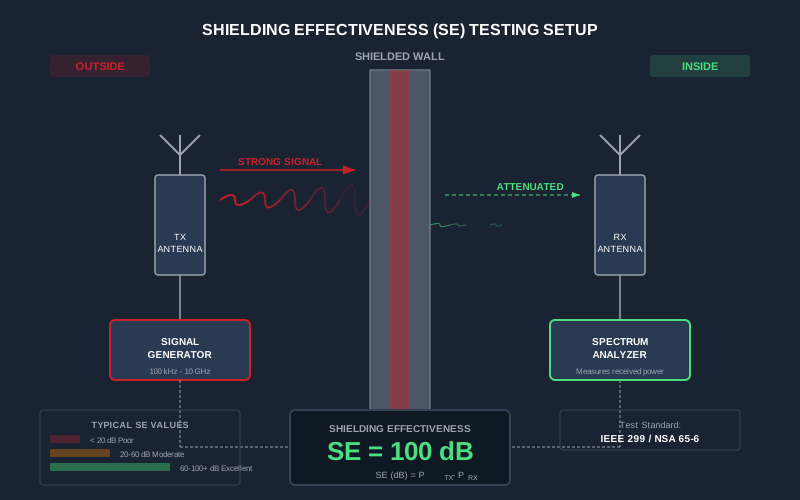
Shielding Effectiveness is the ratio of the electromagnetic field strength measured without the shielding enclosure (reference measurement) to the field strength measured inside the enclosure, expressed in decibels (dB):
The decibel scale is logarithmic, meaning each 20 dB increase represents a 10× improvement in attenuation:
| SE (dB) | Attenuation Factor | % Signal Blocked |
|---|---|---|
| 20 dB | 10× | 90% |
| 40 dB | 100× | 99% |
| 60 dB | 1,000× | 99.9% |
| 80 dB | 10,000× | 99.99% |
| 100 dB | 100,000× | 99.999% |
| 120 dB | 1,000,000× | 99.9999% |
A well-constructed MRI Faraday cage using copper or aluminum panels typically achieves 80–100+ dB of SE at the MRI's operating frequency. The panel material itself may provide 120+ dB, but the overall enclosure SE is limited by the weakest point — usually the RF door seal, observation window, or penetration panel.
Testing Standards
IEEE 299 (IEEE Standard Method for Measuring the Effectiveness of Electromagnetic Shielding Enclosures)
IEEE 299 is the primary reference standard for SE measurement of shielding enclosures. It defines the test methodology, equipment requirements, antenna configurations, and measurement procedures for enclosures larger than 2 meters in any dimension — which includes all MRI rooms. The standard covers measurements from 9 kHz to 18 GHz, encompassing the full frequency range relevant to MRI applications.
ASTM E1851 (Standard Test Method for Electromagnetic Shielding Effectiveness of Durable Wall Construction)
ASTM E1851 provides a complementary test method specifically for architectural shielding enclosures. It addresses field conditions that are common in healthcare construction, including the effects of penetrations, doors, and windows on overall enclosure performance.
MRI Manufacturer Requirements
Each MRI manufacturer specifies SE requirements in their site planning documentation. While they reference IEEE 299 or ASTM E1851 for methodology, the specific SE levels, test frequencies, measurement point locations, and reporting format are defined by the manufacturer. Common requirements include:
- 1.5T systems: 80–100 dB minimum at 63.87 MHz (Larmor frequency)
- 3T systems: 80–100 dB minimum at 127.74 MHz, often with additional requirements at harmonics and sub-harmonics
- 7T research systems: often exceeding 100 dB at 298 MHz with stringent broadband requirements
The shielding contractor must obtain the exact SE specification from the MRI manufacturer before design begins, as this directly influences the choice of shielding material, joint design, and component specifications.
SE Test Procedure
Equipment
A standard SE test requires:
- Signal generator — a calibrated RF source capable of generating test signals across the required frequency range
- Spectrum analyzer or RF receiver — a calibrated instrument to measure the received signal level inside the enclosure
- Transmitting antenna — positioned outside the shielded room, oriented for the specified polarization (typically both horizontal and vertical)
- Receiving antenna — positioned inside the shielded room at the specified measurement points
- Calibrated cables and adapters — with known insertion loss characteristics
Measurement Process
The test follows a reference-and-measure approach:
- Reference measurement: both antennas are placed in a free-space configuration (without the shielding between them) and the received signal level is recorded. This establishes the baseline.
- Shielded measurement: the transmitting antenna is placed outside the shielded room at a specified distance from the wall, and the receiving antenna is placed inside at the corresponding measurement point. The received signal level is recorded.
- SE calculation: the difference between the reference and shielded measurements (in dB) is the Shielding Effectiveness at that point and frequency.
Measurement Points
SE is measured at multiple locations around the enclosure to identify any weak points. Standard measurement points include:
- Center of each wall panel (to verify panel material and joint performance)
- RF door — closed and latched (the most critical and failure-prone component)
- Observation window
- Penetration panel area
- Wall-to-floor and wall-to-ceiling joints
- HVAC waveguide penetrations
- Any other penetration points (quench pipe, sprinkler, etc.)
Common SE Failure Points
When an MRI room fails its SE test, the issue is almost always localized to a specific weak point rather than a general panel failure. The most common failure locations, in order of frequency:
1. RF Door Seal
The RF door is the single most common cause of SE test failures. Door seals degrade from mechanical wear, contamination (paint, drywall dust, adhesive), and improper closure force. Even a tiny gap in the door seal — fractions of a millimeter — can significantly reduce SE at higher frequencies. Ensuring the door frame is plumb, the seals are clean and undamaged, and the closing mechanism provides adequate contact pressure is essential.
2. Penetration Panel
Improperly installed or overloaded penetration panels are a frequent failure source. Every conductor passing through the panel must be properly filtered. Unfiltered cables, missing gaskets, or loose filter connections create direct RF leakage paths. Cable additions made after initial installation are a particular risk if they bypass the filtered panel.
3. Panel Joints
Joints between shielding panels must maintain continuous electrical conductivity. Loose bolts, damaged gaskets, gaps in solder lines, or contamination (rust, paint, oxidation) at joint surfaces reduce conductivity and create leakage paths. Joint quality is especially critical at floor-to-wall transitions, which are subject to building settlement and foot traffic vibration.
4. HVAC Waveguides
HVAC waveguides that are improperly sized (too large a diameter for the cutoff frequency) or have poor connections to the shielding enclosure can leak RF energy. The waveguide must be properly bonded to the Faraday cage with a continuous conductive seal around the full circumference.
5. Construction Damage
Interior finishing trades (drywall, flooring, painting) can inadvertently damage the shielding. Screw penetrations through shielding panels, impact damage, or conductive debris bridging across panel joints are common issues. Close coordination and supervision of all post-shielding construction activity is critical.
SE Certification & Reporting
Upon successful completion of SE testing, the testing contractor issues a formal SE Test Report. This document is a critical project deliverable that typically includes:
- Project identification (facility name, room number, MRI model, date)
- Test methodology reference (IEEE 299, ASTM E1851, or manufacturer-specific protocol)
- Equipment list with calibration certificates
- Measurement point locations (diagram and description)
- Frequency-by-frequency SE results at each measurement point
- Pass/fail determination against the MRI manufacturer's specification
- Tester qualifications and signature
This report serves multiple purposes:
- MRI manufacturer approval: the vendor requires a passing SE report before scheduling magnet delivery
- Warranty documentation: the SE report is part of the shielding system warranty record
- Facility accreditation: the report may be required for Joint Commission, state health department, or ACR accreditation audits
- Baseline for future maintenance: periodic re-testing can be compared against the original certification to identify degradation
Periodic Re-Testing & Maintenance
SE performance can degrade over time due to mechanical wear (particularly RF door seals), building settlement affecting panel joints, corrosion, and modifications to penetrations. Best practices for maintaining SE performance include:
- Annual SE spot-checks at the RF door and penetration panel — the two most vulnerable points
- Full SE re-test every 3–5 years, or whenever the MRI system is upgraded or replaced
- RF door seal inspection every 6–12 months with replacement as needed (seals are a consumable component)
- Strict change control for any penetration modifications — any new cable or pipe through the shielded enclosure must be properly filtered and the SE re-verified at that location
Facilities that experience unexplained MRI image artifacts should include an SE evaluation as part of their troubleshooting process, as RF leakage from degraded shielding is a common root cause of intermittent image quality issues.
Frequently Asked Questions
What SE level does an MRI room need?
Most MRI manufacturers require 80 to 100 dB of Shielding Effectiveness at the scanner's Larmor frequency (63.87 MHz for 1.5T, 127.74 MHz for 3T). Specific requirements vary by manufacturer and scanner model. Higher-field research systems (7T and above) often require 100+ dB. The exact specification is provided in the MRI manufacturer's site planning documentation.
How long does SE testing take?
A comprehensive SE test of an MRI room typically takes 4 to 8 hours, depending on the number of measurement points and frequencies required. The test is performed after the shielding enclosure is complete but before interior finishing (drywall, flooring) is applied, allowing access to all joints and components for remediation if needed.
What happens if the SE test fails?
If the SE test identifies deficiencies, the shielding contractor must locate and repair the leakage point. Common remedies include re-sealing panel joints, adjusting RF door seals, tightening penetration panel connections, or replacing damaged components. The room is then re-tested to confirm compliance. MRI equipment delivery is delayed until a passing SE report is issued.
Who performs SE testing for MRI rooms?
SE testing is typically performed by the RF shielding contractor using calibrated test equipment, or by an independent third-party testing firm. Some MRI manufacturers require testing by an independent party for objectivity. The tester must use calibrated instruments with current calibration certificates and follow the specified test standard (IEEE 299 or equivalent).
How often should MRI room shielding be re-tested?
Best practice recommends annual spot-checks at the RF door and penetration panel, with a comprehensive full-room SE re-test every 3 to 5 years or whenever the MRI system is upgraded or replaced. RF door seals should be inspected every 6 to 12 months as they are subject to mechanical wear.