
Introduction
Magnetic Resonance Imaging (MRI) is one of the most powerful diagnostic tools in modern medicine, producing detailed images of soft tissues, organs, and internal structures without ionizing radiation. However, the extreme sensitivity of MRI scanners to external electromagnetic interference (EMI) — and the powerful radiofrequency (RF) signals they generate — create a critical engineering challenge: the MRI room must be electromagnetically isolated from its surroundings.
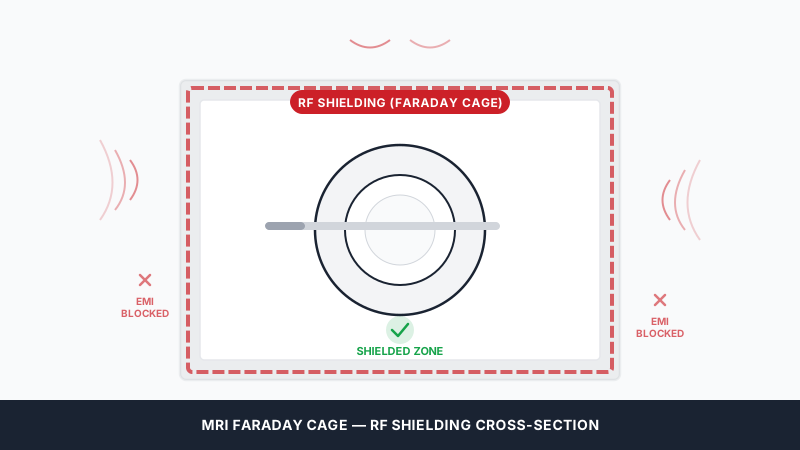
This isolation is achieved through MRI shielding, most commonly in the form of a Faraday cage — a continuous conductive enclosure that surrounds the MRI suite. Without proper shielding, image quality degrades, diagnostic accuracy suffers, and external electronic equipment can be disrupted by the scanner's emissions.
This guide covers the fundamentals of MRI shielding: how it works, what materials are used, how rooms are designed, and what standards must be met for a compliant installation.
Why MRI Shielding Matters
MRI systems operate using three key electromagnetic components: a static magnetic field (measured in Tesla), gradient magnetic fields for spatial encoding, and radiofrequency (RF) pulses to excite hydrogen atoms in the body. The RF component, typically ranging from 8 MHz to 300 MHz depending on field strength, is both the source of the diagnostic signal and the primary reason shielding is required.
Protecting Image Quality
External RF interference — from cell phones, Wi-Fi routers, broadcast signals, nearby medical equipment, or even fluorescent lighting — can appear as artifacts in MRI images. These artifacts can mimic pathology, obscure critical findings, or force repeat scans that delay patient care and waste operational time.
Containing RF Emissions
MRI scanners emit significant RF energy during operation. Without containment, these emissions can interfere with other sensitive electronic equipment in the facility, including patient monitoring systems, surgical navigation tools, and adjacent imaging equipment.
Regulatory Compliance
MRI installations must meet electromagnetic compatibility (EMC) standards and the shielding requirements specified by the MRI manufacturer. Failure to achieve the required Shielding Effectiveness (SE) can void equipment warranties, delay facility accreditation, and compromise patient safety.
How Faraday Cages Work
A Faraday cage is a continuous enclosure made of conductive material that blocks electromagnetic fields. The principle, first demonstrated by Michael Faraday in 1836, relies on the redistribution of electrical charges within the conductor: when an external electromagnetic field encounters the cage, it induces opposing charges on the cage's surface that cancel the field within the interior.
Key Design Principles
For MRI applications, the Faraday cage must form a six-sided, electrically continuous enclosure — floor, ceiling, and all four walls — with no gaps or discontinuities that would allow RF energy to pass through. Every opening in the room (doors, windows, ventilation, cable penetrations) must be treated with RF-attenuating solutions:
- RF doors use finger-stock contacts or knife-blade seals to maintain conductivity across the door frame.
- Observation windows employ copper mesh laminated between glass panes, or conductive glass coatings.
- Waveguides allow air (HVAC) and cabling to pass through the shield while attenuating RF energy below the cutoff frequency.
- Penetration panels with filtered connectors handle power, data, and medical gas lines entering the room.
Shielding Materials
The two most common materials for MRI Faraday cages are copper and galvanized steel (or aluminum). Copper offers excellent conductivity and is the traditional choice for high-performance RF shielding. Aluminum provides a lighter, cost-effective alternative with very good RF attenuation. The choice depends on the MRI field strength, required SE levels, facility constraints, and budget. For a detailed comparison, see our guide on copper vs aluminum for MRI Faraday cages.
Modern prefabricated shielding systems use modular panels — typically copper or aluminum sheets bonded to structural substrates — that interlock to form a continuous cage. Joints are sealed with conductive gaskets or soldered/welded to ensure electrical continuity.
Types of MRI Shielding
RF Shielding (Radiofrequency)
RF shielding is the primary requirement for every MRI installation. It blocks radiofrequency electromagnetic fields in the MHz range. This is what the Faraday cage provides — a continuous conductive enclosure tuned to attenuate the Larmor frequency of the installed MRI system. For a 1.5T system, the Larmor frequency is approximately 63.87 MHz; for a 3T system, approximately 127.74 MHz.
Magnetic Shielding
Magnetic shielding addresses the static magnetic field (the "fringe field") that extends beyond the MRI bore. While modern superconducting magnets are actively shielded to minimize fringe field, some installations require additional passive magnetic shielding using ferromagnetic materials (steel plates) to contain the 5-gauss line within the MRI room or a defined perimeter. This is particularly important when the MRI room is adjacent to public corridors, offices, or other sensitive areas. Learn more about the differences in our RF shielding vs magnetic shielding comparison.
Vibration Shielding
MRI gradient coils produce rapid magnetic field changes that can cause mechanical vibration. In sensitive environments (near research labs, upper floors), vibration isolation may be required to prevent the MRI's mechanical noise from affecting adjacent spaces.
Shielding Effectiveness (SE) Testing
Shielding Effectiveness is the quantitative measure of how well a shielded enclosure attenuates electromagnetic energy, expressed in decibels (dB). It is calculated as the ratio of the field strength outside the enclosure to the field strength inside:
Typical SE Requirements
MRI manufacturers specify minimum SE values that the room must achieve before the scanner can be installed. Common requirements include:
- 1.5T systems: typically 80–100 dB at the Larmor frequency (63.87 MHz)
- 3T systems: typically 80–100 dB at the Larmor frequency (127.74 MHz) with additional requirements at harmonics
- 7T and above: requirements vary but are generally more stringent, often exceeding 100 dB
An SE of 100 dB means the external RF signal is attenuated by a factor of 100,000 — only 0.001% of the original energy penetrates the enclosure.
Testing Procedure
SE testing is performed using a calibrated signal generator and receiver. A transmitting antenna is placed outside the shielded room, and a receiving antenna inside. The signal attenuation is measured across a range of frequencies to verify compliance at the Larmor frequency and across the diagnostic bandwidth. Testing follows established standards (e.g., IEEE 299) and is performed at multiple points including door seals, observation windows, penetration panels, and wall/floor/ceiling joints.
A professional SE test report is issued after installation, certifying that the room meets the MRI manufacturer's specifications. This document is typically required for equipment warranty validation and facility accreditation.
Planning an MRI Room
Successful MRI room construction requires careful coordination between the shielding contractor, the MRI manufacturer, the architect, structural engineers, and MEP (Mechanical, Electrical, Plumbing) consultants. Key considerations include:
Room Dimensions and Layout
The shielded room must accommodate the MRI scanner with adequate clearance for patient access, service access, and the 5-gauss fringe field line. MRI manufacturers provide detailed site planning guides specifying minimum room dimensions, floor loading requirements, and the location of the penetration panel.
Structural Requirements
MRI systems are heavy — a typical 1.5T superconducting magnet weighs 4,000–6,000 kg, and 3T systems can exceed 7,000 kg. The floor must be designed to support this concentrated load, plus the weight of the shielding enclosure itself. A reinforced concrete slab with appropriate load distribution is standard.
HVAC and Ventilation
The MRI room requires dedicated climate control to maintain stable operating temperatures (typically 18–22°C) and manage the heat generated by the scanner's electronics and gradient coils. All ductwork penetrating the shielded enclosure must pass through RF waveguides — hollow tubes sized below the cutoff frequency to attenuate RF energy while allowing airflow.
Electrical and Data Penetrations
Every electrical conductor entering the shielded room is a potential path for RF leakage. Filtered penetration panels with Pi-filters or capacitive filters are used for power lines, data cables, patient monitoring connections, and medical gas alarms. Fiber-optic cables, being non-conductive, can pass through waveguides without RF filtering.
Quench Pipe
Superconducting MRI magnets require a quench pipe — a dedicated exhaust duct that vents helium gas outside the building in the event of a magnet quench (sudden loss of superconductivity). This pipe must be properly sized, routed, and integrated with the shielded enclosure without compromising RF integrity.
The Installation Process
A typical MRI shielding installation follows a structured sequence:
- Site Survey & Design: detailed measurements, structural assessment, and coordination with the MRI manufacturer's site planning requirements.
- Engineering & Manufacturing: custom design of the Faraday cage panels, RF door, observation window, penetration panel, and waveguides — all manufactured to the specific room dimensions.
- Delivery & Assembly: prefabricated shielding components are shipped as a flat-pack kit and assembled on-site by specialized technicians. Modular panel systems allow rapid installation, often completing the shielding enclosure in 3–5 days.
- Sealing & Finishing: all joints are sealed for RF continuity. Interior finishes (drywall, flooring, ceiling) are applied over the shielding layer. Patient-comfort elements such as mood lighting and decorative wall panels can be integrated at this stage.
- SE Testing & Certification: a comprehensive SE test is performed to verify the enclosure meets specifications. A certified test report is delivered.
- MRI Installation: once the shielded room is certified, the MRI manufacturer proceeds with magnet delivery, installation, and commissioning.
Frequently Asked Questions
What is a Faraday cage in MRI?
A Faraday cage for MRI is a six-sided conductive enclosure (walls, floor, ceiling) that surrounds the MRI scanner room. It blocks external radiofrequency (RF) interference from degrading image quality and prevents the MRI's own RF emissions from interfering with nearby equipment. The cage is typically constructed from copper or aluminum panels with specialized RF doors, shielded observation windows, and filtered penetration panels.
How much does MRI room shielding cost?
MRI shielding costs vary significantly based on room size, MRI field strength, shielding material (copper vs. aluminum), required SE levels, and project complexity. As a general range, expect the shielding enclosure (Faraday cage, RF door, window, penetration panel) to represent 10–20% of the total MRI suite construction budget. Contact a specialized shielding contractor for an accurate quote based on your specific project requirements.
What is Shielding Effectiveness (SE) and how is it measured?
Shielding Effectiveness (SE) measures how much a shielded enclosure attenuates electromagnetic signals, expressed in decibels (dB). It is measured by transmitting a calibrated RF signal outside the room and measuring the attenuated signal inside. Typical MRI installations require 80–100 dB of attenuation at the scanner's Larmor frequency. Testing follows IEEE 299 standards and is performed at multiple points around the enclosure.
What materials are used for MRI shielding?
The most common materials are copper and aluminum (or galvanized steel). Copper provides excellent RF conductivity and is the traditional choice for high-performance installations. Aluminum offers a lighter, more cost-effective alternative with very good attenuation. The choice depends on MRI field strength, required SE levels, structural constraints, and budget.
How long does MRI room shielding installation take?
With prefabricated modular panel systems, the shielding enclosure (Faraday cage) can typically be assembled on-site in 3–5 working days. However, the complete MRI room project — including civil works, electrical infrastructure, HVAC, shielding, finishing, and SE testing — typically spans 4–12 weeks depending on project scope and site readiness.
Can existing MRI shielding be upgraded or replaced?
Yes. Existing MRI rooms can be re-shielded to accommodate new, higher-field-strength MRI systems or to address SE deficiencies. The process involves assessing the current shielding, designing an upgrade solution (which may involve replacing panels, doors, windows, or the entire enclosure), and re-testing to certify compliance with the new scanner's requirements.
Do veterinary MRI systems need shielding?
Yes. Veterinary MRI systems operate on the same electromagnetic principles as medical MRI and require the same RF shielding to ensure image quality and prevent interference. The Faraday cage design is adapted to the specific scanner model and veterinary facility layout, but the shielding standards and SE testing requirements are equivalent.