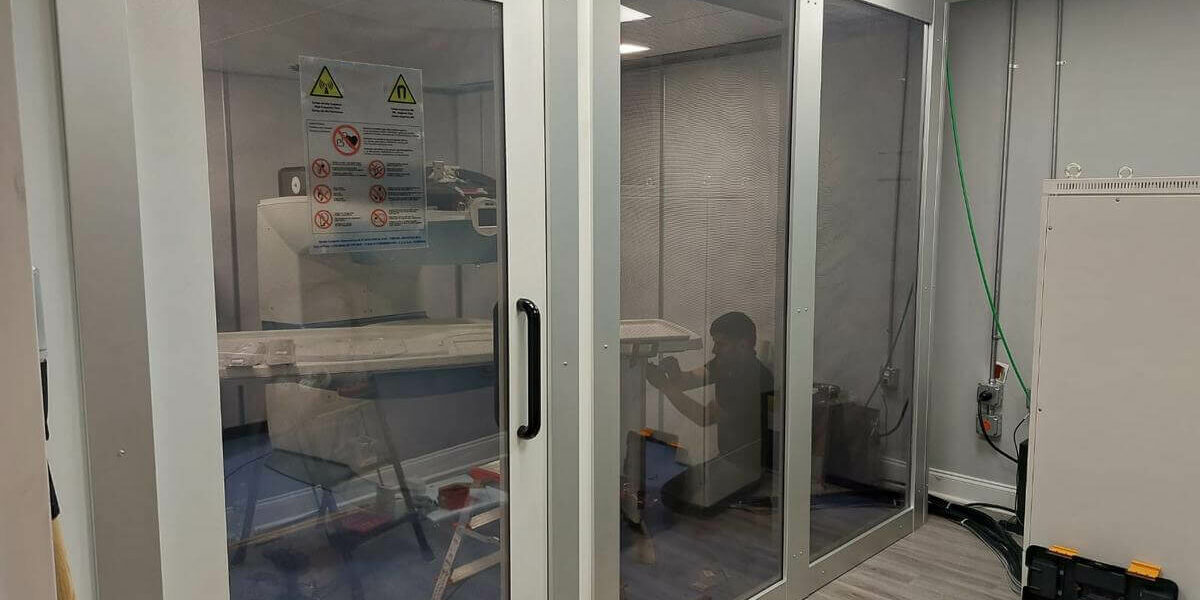
In an MRI environment, the RF shield is only as strong as its most frequent point of failure: the door. While the walls, floor, and ceiling of a Faraday cage are static, the RF door is a dynamic mechanical system that must maintain a perfect electrical bond with the rest of the shield every time it closes. Engineering these doors requires a balance of high-conductivity metallurgy, precision mechanics, and acoustic management.
The Challenge of Electrical Continuity
For a Faraday cage to function, RF currents must flow unimpeded across the entire surface of the enclosure. When a door is opened, that continuity is broken. The engineering challenge is to “repair” that electrical skin the moment the door latches. Even a gap of a few millimeters—or a slight layer of oxidation on the contact points—can allow external radio frequency interference to enter the room, leading to RF leakage and signal noise that degrades diagnostic images.
Key Mechanisms: Gaskets and Fingerstock
To bridge the gap between the door leaf and the frame, engineers utilize two primary contact methods:
Beryllium Copper Fingerstock: These are high-performance, spring-like gaskets that line the perimeter of the door. When the door closes, these “fingers” are compressed against the frame, creating hundreds of individual points of contact. Beryllium copper is chosen for its unique combination of excellent conductivity and “memory”—the ability to return to its original shape after thousands of compressions.
Pneumatic Sealing Systems: Some advanced doors use an inflatable conductive gasket. When the door is closed, the gasket inflates with compressed air, forcing a conductive surface against the frame. This provides a high-integrity seal and is often quieter than mechanical fingerstock systems.
Acoustic and Structural Integration
Modern MRI machines produce significant acoustic noise due to the rapid switching of gradient coils. Therefore, an RF door is rarely just an RF shield; it is also an acoustic barrier.
Mass-Loaded Cores: RF doors are engineered with heavy internal damping materials to attenuate sound, often weighing hundreds of kilograms.
Precision Hinges: Because of the extreme weight required for acoustic insulation, the hinges must be over-engineered to prevent “sagging.” Even a fraction of a degree of tilt can misalign the RF contact points, compromising the shield’s decibel (dB) rating.
The Importance of the Threshold
The bottom of the door, or the threshold, is arguably the most difficult area to engineer. It must be flush enough to allow patient gurneys to pass through smoothly (ADA compliance) while still providing a robust RF seal. Most high-end doors utilize a “recessed” contact system or a drop-down conductive seal that engages only when the door is fully latched.
Maintenance and Lifecycle
Unlike the static panels of the room, RF doors require periodic maintenance. The contact surfaces (the “brass” or “copper” strips) must be kept free of dirt, skin oils, and oxidation.
Cleaning: Regular cleaning with specialized non-residue solutions ensures the contact resistance remains low.
Replacement: Fingerstock is a consumable component. Over time, individual fingers may break or lose their tension, requiring professional replacement to maintain the room’s certification.
Frequently Asked Questions
How often should RF door gaskets be replaced?
In a high-traffic hospital environment, gaskets should be inspected every six months. Depending on usage and maintenance, fingerstock typically lasts between 2 to 5 years before requiring replacement to maintain 100dB attenuation.
Why is my MRI door becoming difficult to open or close?
This is usually a sign of hinge fatigue or mechanical misalignment. Because these doors are incredibly heavy for acoustic reasons, even a slight shift can cause the RF fingers to catch or the latching mechanism to bind. Immediate adjustment is necessary to prevent damaging the RF seal.
Can an RF door affect the MRI’s image quality?
Absolutely. If the door does not seal perfectly, “stray” RF signals from the hallway (mobile phones, Wi-Fi, radio) can enter the bore. This appears on the scan as “zipper artifacts” or a general increase in background noise (lower SNR).
Are sliding RF doors better than swing doors?
Sliding doors are excellent for saving space and can offer superior acoustic sealing, but they are mechanically more complex. Swing doors are generally more common due to their simpler maintenance and lower cost, though they require a larger “swing zone” in the control area.
Need help or have a project in mind?
Share the details with us! Our experts are at your disposal and ready to support you every step of the way, showing you the best solution for your needs.
Call us at +1 646 372 2191 or write us at info@qualityshielding.com