In MRI environments, controlling radiofrequency (RF) interference is essential to ensure superior image quality and reliable system performance. One of the most effective solutions for electromagnetic compatibility is the Faraday cage. While the physical concept is well-established, its application in MRI room design involves complex engineering principles and specific technical considerations.
The Physics of RF Shielding: How a Faraday Cage Works
A Faraday cage operates by creating a continuous conductive enclosure that blocks external radiofrequency signals from entering a protected space. When electromagnetic waves encounter the conductive surface, the free electrical charges within the material redistribute themselves, effectively cancelling the field’s effects inside the enclosure.
In MRI applications, this principle is used to isolate the scanner from external RF noise (such as radio broadcasts or electronic equipment) that could compromise signal reception. Simultaneously, it prevents the high-frequency emissions generated during imaging sequences from escaping the room and interfering with other hospital devices.
Implementation of RF Shielding in MRI Suites
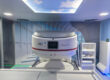
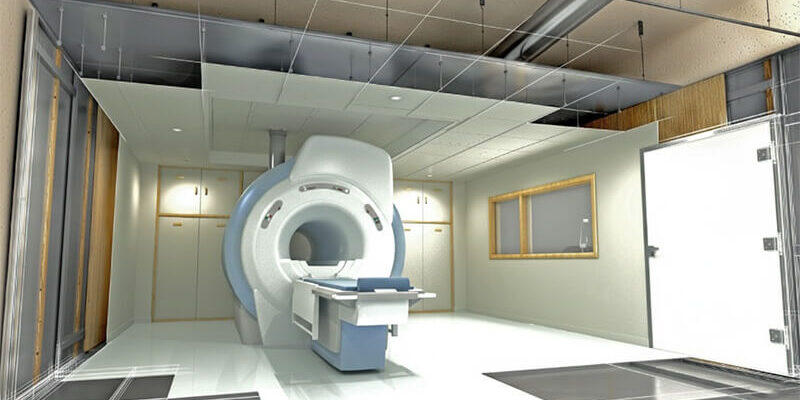
In a professional MRI installation, the Faraday cage is not just a box but a sophisticated architectural integration. It is typically built into the walls, ceiling, and floor to form a fully enclosed RF-shielded volume. High-grade conductive materials, such as copper foil or aluminum panels, are assembled with precise overlaps and high-pressure mechanical bonding to ensure perfect electrical continuity.
Key components of a high-performance MRI Faraday cage include:
RF Shielded Doors: Featuring specialized gaskets or “fingers” to maintain a seal.
Observation Windows: Utilizing double-layered fine copper mesh.
Waveguide Filters: To allow medical gases and fiber optics to enter without leaking RF.
Power Line Filters: To prevent interference from traveling through electrical wiring.
Why Conductivity and Structural Integrity are Critical
The shielding effectiveness (SE) of a Faraday cage depends entirely on the quality of its construction. Even microscopic gaps, oxidized joints, or improperly sealed penetrations can act as antennas, leading to RF leakage. In MRI environments, such imperfections often result in image artifacts, increased background noise, and a significant drop in the signal-to-noise ratio (SNR), which reduces diagnostic accuracy.
For this reason, Faraday cages used in clinical settings are subjected to rigorous RF testing (typically following MIL-STD or specialized medical standards) to ensure consistent decibel (dB) attenuation across the required frequency spectrum.
The Impact of Faraday Cages on MRI Performance
By creating a stable and controlled electromagnetic environment, the Faraday cage allows the MRI system to operate at its maximum sensitivity. This infrastructure is a fundamental component of MRI facility design, directly supporting image repeatability and overall system uptime. Investing in high-quality RF shielding solutions is essential for any facility aiming for excellence in diagnostic imaging.
Need help or have a project in mind?
Share the details with us! Our experts are at your disposal and ready to support you every step of the way, showing you the best solution for your needs.
Call us at +1 646 372 2191 or write us at info@qualityshielding.com