The effectiveness of an MRI Faraday cage is defined by its ability to attenuate external electromagnetic interference. However, the “best” material is not a universal constant; it is a balance between electrical conductivity, mechanical durability, and site-specific constraints. To achieve the required 100dB+ attenuation, engineers must evaluate materials based on their skin depth, permeability, and how they behave at the seams.
1. Copper: The Industry Gold Standard
Copper is globally recognized as the premier material for RF shielding in high-field MRI environments. Its atomic structure allows for maximum electron mobility, which is essential for reflecting high-frequency waves.
* Surface Conductivity: Copper has the highest conductivity of any non-precious metal, meaning it can be much thinner than other materials while providing superior protection.
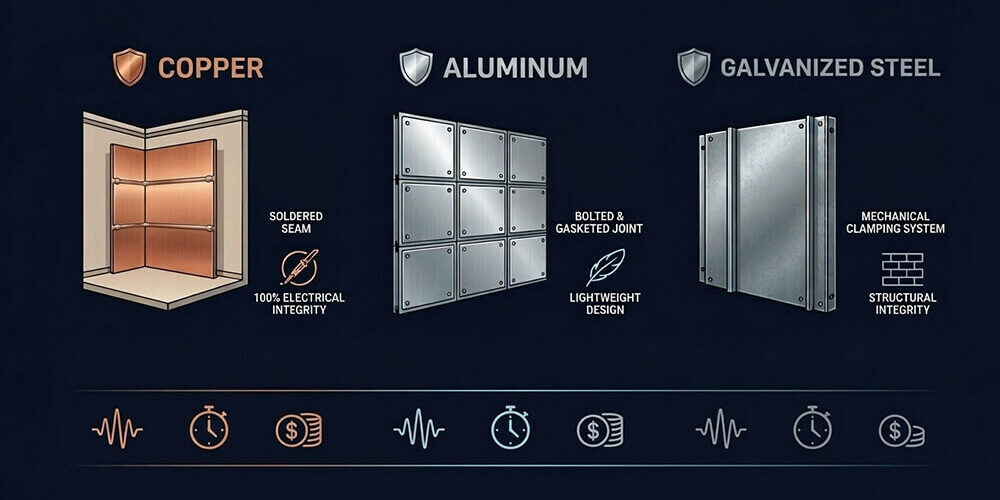
* Solderability: One of copper’s greatest advantages is the ability to create homogeneous seams. By soldering the joints, the entire room becomes a single, continuous electrical “skin.” This prevents the creation of microscopic gaps that often lead to RF leakage and signal interference, which can severely degrade image quality in diagnostic settings.
* Longevity: While copper patinas, its oxides remain relatively conductive compared to aluminum, ensuring that the shield doesn’t “age out” of compliance.
2. Aluminum: The Modular Powerhouse
Aluminum is the material of choice for “pan-style” modular shielding. It offers a unique combination of lightness and rigidity.
* Weight-to-Performance Ratio: Aluminum is roughly one-third the weight of steel. This makes it ideal for shielding rooms located on upper floors where structural load-bearing capacity is limited.
* Bolted Integrity: Unlike copper, which is often thin and flexible, aluminum is used in thick, rigid panels. These are bolted together with specialized RF gaskets. This modularity allows for faster installation and the possibility of relocating the shield in the future.
* The Oxide Challenge: Aluminum quickly forms a non-conductive oxide layer. Professional installers must use specialized treatments or high-pressure contact surfaces to ensure that every panel is electrically bonded to the next.
3. Galvanized Steel: The Structural Hybrid
Galvanized steel (zinc-coated) is used when the RF shield needs to double as a robust structural element or when a baseline of magnetic attenuation is also required.
* Physical Protection: Steel panels are highly resistant to mechanical damage during hospital renovations or heavy equipment movement.
* Cost Efficiency: For large-scale projects, galvanized steel offers a lower material cost while still meeting the standard 80-100dB attenuation requirements if the joints are correctly engineered.
* Seam Management: Steel systems typically rely on mechanical clamping. The precision of the zinc coating is vital here to prevent galvanic corrosion between the panels.
Technical Material Breakdown
Copper Shielding
Best for high-specification, permanent 3T+ systems. It utilizes soldering or high-pressure clamping to ensure excellent conductivity and long-term joint stability.
Aluminum Shielding
Best for modular and lightweight installations. It relies on bolted joints with specialized RF gaskets to maintain a high strength-to-weight ratio.
Galvanized Steel Shielding
Best for structural-focused or lower-budget projects. It uses clamped or bolted mechanical joints and provides a baseline level of physical and magnetic protection.
Frequently Asked Questions
Which material provides the highest RF attenuation?
While all three main materials can reach the 100dB threshold, copper is technically superior due to its higher conductivity. It requires less thickness to achieve the same “skin depth” protection compared to aluminum or steel.
Why is copper more expensive than other shielding materials?
The cost of copper is driven by its global commodity value and its superior physical properties. However, its longevity and the security of soldered joints often result in a lower total cost of ownership by reducing the need for future RF leak repairs.
Can I mix different materials in the same RF shield?
It is generally discouraged due to galvanic corrosion. When two dissimilar metals touch in the presence of even slight humidity, they can corrode at the contact point, creating an RF leak. If mixing is necessary, specialized dielectric buffers must be used.
Does the thickness of the material matter for RF shielding?
Yes, but only up to a point called the “skin depth.” For MRI frequencies (typically 64MHz to 128MHz), the RF current only flows on the surface of the metal. Once the material is thicker than the skin depth, adding more thickness does not significantly improve RF shielding, though it may improve structural rigidity.
Is aluminum better for modular MRI rooms?
Often, yes. Because aluminum panels are rigid, they can be manufactured as self-supporting “pans” that bolt together. This makes the installation cleaner and faster than laying copper foil over a wooden frame, and it allows the room to be disassembled if the hospital needs to move the MRI suite.
Need help or have a project in mind?
Share the details with us! Our experts are at your disposal and ready to support you every step of the way, showing you the best solution for your needs.
Call us at +1 646 372 2191 or write us at info@qualityshielding.com