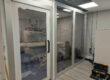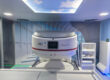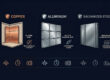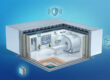
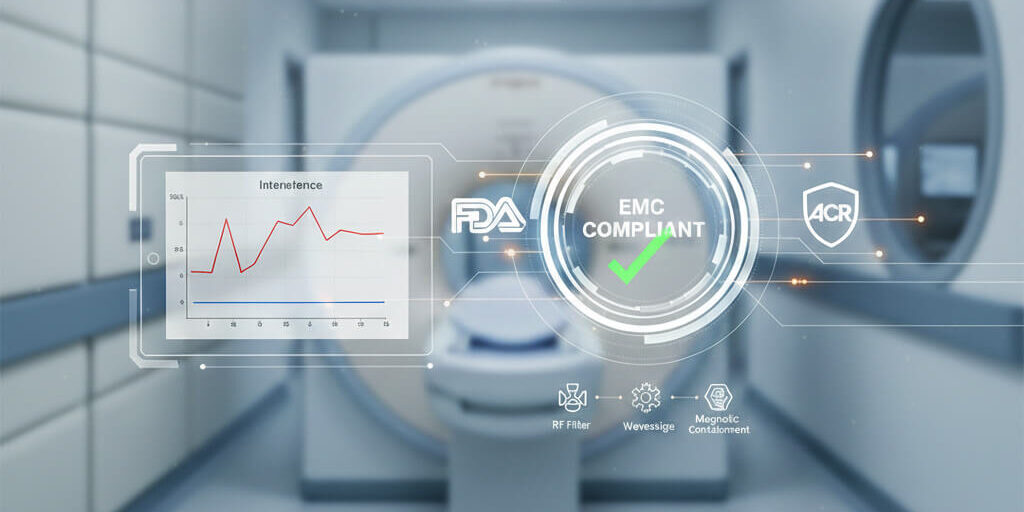
Electromagnetic Compatibility (EMC) is the invisible backbone of any functional diagnostic department. In the context of Magnetic Resonance Imaging, EMC compliance isn’t just a regulatory checkbox; it is a technical necessity. Without a rigorous shielding strategy, the delicate balance between the MRI’s high-frequency pulses and the surrounding electronic environment would collapse, leading to failed inspections and compromised diagnostics.
To achieve this, the Faraday cage must act as a bidirectional barrier, fulfilling specific performance guarantees that align with international EMC standards.
1. External Interference Suppression (RF Attenuation)
The primary guarantee of an EMC-compliant shield is the suppression of external Radio Frequency (RF) noise. MRI systems operate by detecting incredibly faint signals from the patient’s body. Any “stray” RF from radio stations, mobile networks, or hospital equipment can drown out these signals.
An EMC-certified shield must guarantee:
- Attenuation Levels: Typically a minimum of 80dB to 100dB across a frequency range from 10 MHz to 130 MHz (depending on the Tesla strength of the magnet).
- Signal Purity: Ensuring the “noise floor” within the room remains low enough for the MRI to achieve its maximum signal-to-noise ratio (SNR).
2. Protection of the Hospital Environment
Compliance is a two-way street. While the room must be protected from the outside, the hospital’s sensitive electronics—such as pacemakers in corridors, EEG monitors, or laboratory equipment—must be protected from the MRI itself.
Magnetic shielding (using silicon steel or low-carbon steel) guarantees the containment of the fringe field. EMC compliance ensures that the powerful magnetic forces do not interfere with the life-critical devices of patients and staff moving outside the exam room.
3. Integration of Penetration Pathways
A shield is only as strong as its weakest point. EMC compliance must be guaranteed even where services enter the room. This involves specialized components that prevent “leaks”:
- RF Filters: Every power and data line entering the room must pass through a low-pass filter to strip away interference.
- Waveguides: Non-conductive pipes (for medical gases or fiber optics) that are dimensioned to prevent RF waves from passing through.
4. Structural Continuity and Grounding
To guarantee EMC, the entire Faraday cage must be electrically continuous and connected to a single, dedicated RF Ground. This prevents the shield from becoming an antenna itself. Compliance testing verifies that there are no “hot spots” or potential differences between panels that could generate electromagnetic disturbances during a scan.
Conclusion: The Guarantee of Performance
An EMC-compliant MRI facility provides peace of mind. It guarantees that the site will pass final acceptance tests (FAT) and that the MRI manufacturer will not void the warranty due to site interference. Ultimately, investing in certified EMC shielding is an investment in diagnostic certainty—ensuring that every image captured is clear, accurate, and free from artifacts.
Need help or have a project in mind?
Share the details with us! Our experts are at your disposal and ready to support you every step of the way, showing you the best solution for your needs.
Call us at +1 646 372 2191 or write us at info@qualityshielding.com