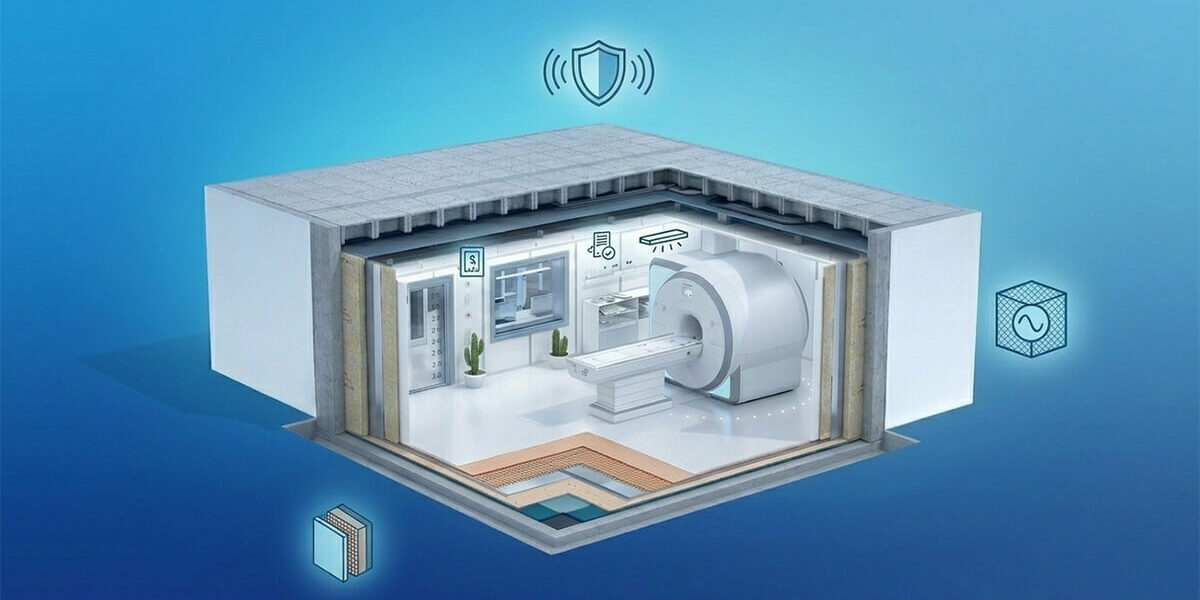
The transition from standard 1.5T systems to high-field magnets (3T and beyond) has transformed MRI suite design from a specialized construction practice into a high-stakes physics engineering challenge. As the static field strength ($B_0$) increases, the performance of the Faraday cage becomes exponentially more critical to diagnostic success.
Higher frequencies and shorter wavelengths
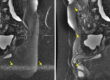
In high-field imaging, the Larmor frequency increases proportionally with field strength. While a 1.5T system operates at approximately 64 MHz, a 3T system doubles that to roughly 128 MHz. This shift is fundamental because shorter wavelengths can “find” smaller gaps in the shielding. A micro-fissure that might have been negligible for a 1.5T magnet can become a radiating antenna for a 3T system, introducing noise that masks subtle pathologies. Understanding how Faraday cages work in MRI applications is essential to realize why higher frequencies demand absolute electrical continuity and zero-tolerance for shielding breaches.
Stricter attenuation and signal-to-noise requirements
While 80-90 dB of attenuation might suffice for standard magnets, the gold standard for high-field systems is now consistently 100 dB or higher. This requires:
* Perfected mechanical seams or continuous seam welding.
* Precision-engineered penetration panels that filter out even the smallest ambient interference.
* Advanced RF door designs with high-performance contact strips (fingerstock) to maintain the seal under constant use.
Managing Eddy Currents and Gradient Noise
The faster and more powerful gradients of 3T and 7T systems can induce Eddy currents in the shielding walls if they are not correctly positioned or designed. If the conductive shield is too close to the magnet, these induced currents can degrade the stability of the magnetic field, affecting sensitive sequences like functional MRI (fMRI) or spectroscopy. Proper spatial planning and material choice are vital to mitigate these electromagnetic interactions.
Structural load and acoustic vibration
High-field magnets are often heavier and generate significantly more acoustic noise and vibration due to increased Lorentz forces. The shielding must be integrated with sophisticated vibration isolation systems. If the cage joints are subjected to constant vibration without proper damping, they can fail over time, leading to RF leaks that are difficult to diagnose post-installation.
Magnetic containment and Safety Zones
With high-field magnets, the “5-gauss line” extends much further from the bore. This forces designers to reconsider the physical footprint of the suite. In many cases, massive passive magnetic shielding (silicon steel plating) must be integrated directly with the RF shield. This dual-layer approach is necessary to ensure that the magnetic field remains contained within the ACR-defined Zone IV, protecting both staff and patients in the surrounding areas.
Need help or have a project in mind?
Share the details with us! Our experts are at your disposal and ready to support you every step of the way, showing you the best solution for your needs.
Call us at +1 646 372 2191 or write us at info@qualityshielding.com