
What extremity and MSK MRI systems are
Not every MRI scans the whole body. Extremity MRI systems are compact, dedicated scanners designed to image a single limb — a knee, wrist, ankle, elbow, or foot — rather than the entire patient. They are popular in orthopedic clinics, sports medicine practices, and musculoskeletal (MSK) imaging centers because they are smaller, less expensive to install, and let a patient sit comfortably while only the limb is placed in the magnet.
Because these systems are small and often low-field, it is a common misconception that they do not need shielding. In reality, an extremity scanner detects the same weak radio-frequency signals as a full-body system and is just as vulnerable to external interference. It still requires an RF shielded enclosure — the scale and construction differ from a full MRI suite, but the underlying need for a Faraday cage does not.
Why compact scanners still need a Faraday cage
The purpose of RF shielding is to keep external electromagnetic noise away from the scanner's sensitive receiver, and that requirement is independent of the scanner's size. Extremity systems are frequently installed in clinics located in commercial buildings, medical office parks, or mixed-use spaces where EMI and RFI sources — nearby electronics, elevators, radio transmitters, and switching power supplies — are common. Without adequate shielding, these signals appear in the images as artifacts that can obscure the fine detail MSK imaging depends on.
Because many extremity scanners operate at lower field strengths, the received signal is weaker, which can make image quality especially sensitive to interference. That reinforces rather than reduces the case for a well-designed enclosure. The shielding must meet the scanner manufacturer's specification, and that specification exists precisely because the manufacturer knows the system cannot deliver diagnostic image quality in an unshielded environment.
Enclosure design for a smaller footprint
The advantage of an extremity system is that the shielded enclosure is much smaller than a full MRI suite. The magnet is compact and light, the static fringe field is small — often contained within or very close to the scanner, so passive magnetic shielding is usually unnecessary — and many systems are permanent-magnet designs with no cryogens and therefore no quench pipe. This removes several of the most demanding elements of a full-field installation.
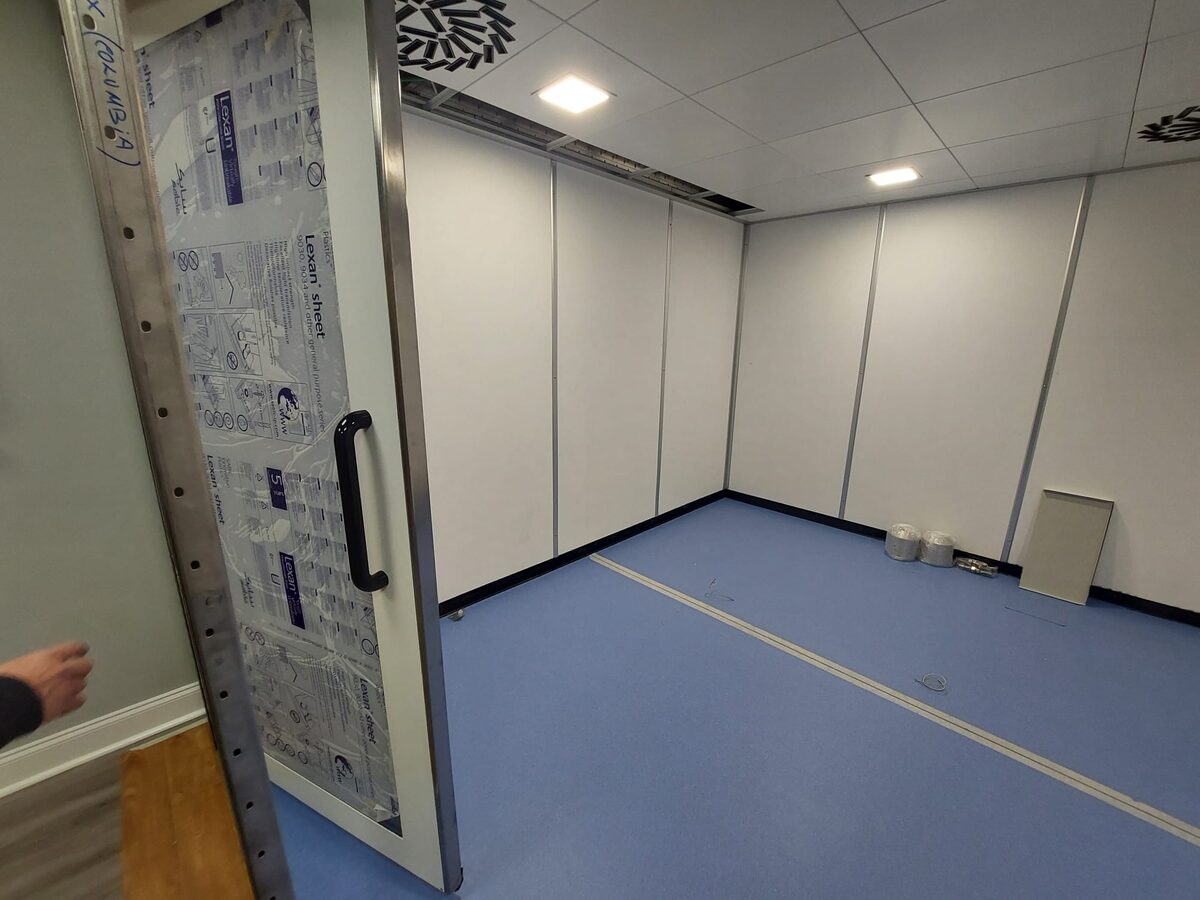
What remains is a properly constructed RF enclosure sized to the scanner and the clinical workspace around it. A modular Faraday cage is often ideal, because it can be assembled within an existing clinic room without major construction and can be relocated if the practice moves. The shielded door and any cable penetrations still need proper design and sealing, but the overall project is lighter and faster than a hospital MRI suite.
Siting in a clinic environment
Extremity MRI is usually installed in outpatient orthopedic and sports-medicine settings rather than hospitals, which shapes the shielding project. The room is often a converted clinic space with constraints on ceiling height, floor loading, and access. The compact scanner and its small enclosure fit these constraints well, but the surrounding electromagnetic environment still has to be assessed — a clinic sharing a building with other tenants can host RF sources that need to be considered during design.
Because the fringe field is small, the safety zoning around an extremity system is far less demanding than for a full-field magnet, though basic MRI safety practices still apply to anyone entering the room. The main shielding focus is the RF enclosure and its ability to keep the local environment's interference out, so the scanner can produce the high-resolution images that MSK diagnosis requires.
Testing and verification
Like any MRI enclosure, an extremity or MSK installation should undergo shielding effectiveness testing after construction to confirm it meets the scanner manufacturer's specification. This is the step that turns an assumption about shielding performance into documented, verified attenuation, and it protects the practice's investment by establishing that the room performs before the scanner is commissioned.
Because these systems are frequently sited in clinics with changing neighbors and building uses, it is worth confirming shielding performance if the surrounding environment changes significantly — a new tenant with heavy electrical equipment, for example. Building shielding verification into the project plan from the start ensures the compact scanner delivers reliable MSK image quality throughout its service life.
Frequently Asked Questions
Do compact extremity MRI scanners really need RF shielding?
Yes. An extremity scanner detects the same weak RF signals as a full-body system and is just as vulnerable to external interference. Because many are lower-field, image quality can be especially sensitive to environmental RF. A properly designed RF enclosure that meets the manufacturer's specification is required for diagnostic image quality.
Does an extremity MRI need magnetic shielding and a quench pipe?
Usually not. Most extremity systems are compact, often permanent-magnet designs with a small static fringe field contained within or near the scanner, so passive magnetic shielding is typically unnecessary. Permanent-magnet systems also use no cryogens, so there is no quench pipe. The main requirement is a well-constructed RF enclosure.
Can an extremity MRI be installed in an existing clinic room?
Yes. The compact scanner and its small enclosure fit clinic spaces well, and a modular Faraday cage can be assembled in an existing room without major construction, and relocated if the practice moves. Ceiling height, floor loading, and the local RF environment should still be assessed during design.