The installation of a high-field MRI suite is one of the most demanding engineering tasks in modern healthcare construction. Unlike standard medical imaging rooms, an MRI environment requires a perfect synergy between architectural stability, radiofrequency (RF) isolation, and magnetic field containment. Successfully managing these technical complexities—especially in dense urban centers or aging infrastructures—requires a proactive engineering approach that goes far beyond the simple assembly of a Faraday cage.
Mitigation of external electromagnetic interference (EMI)
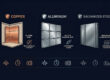
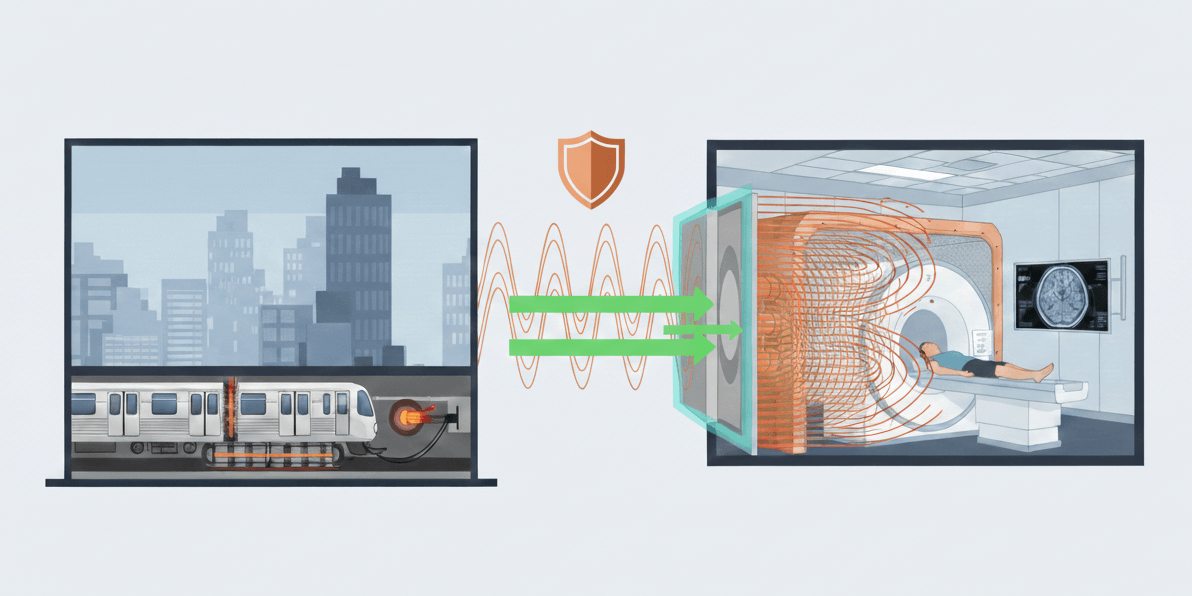
In major US metropolitan areas, the proximity of MRI sites to subway lines, light rails, or heavy electrical infrastructure introduces low-frequency electromagnetic interference. While a standard shield is highly effective against RF noise, the choice between copper vs aluminum in MRI shielding is critical depending on the environmental EMI profile. Specific conductive properties are required to effectively stabilize the fringe field and ensure that the magnet’s homogeneity remains within strict parts-per-million (ppm) specifications.
Structural vibration and acoustic isolation
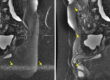
High-field magnets, particularly 3T systems, are extremely sensitive to mechanical vibrations. In repurposed buildings or multi-story medical office buildings (MOBs), floor vibrations from HVAC units or nearby traffic can translate into “ghosting” artifacts on the diagnostic image. A sophisticated shielding design must incorporate vibration-isolated floor systems, decoupling the magnet room’s floor from the building’s primary structure using specialized elastomeric mounts or inertia bases.
Managing the 5-Gauss exclusion zone in confined spaces
In the US, safety protocols often dictate that the 5-Gauss line—the threshold beyond which the magnetic field can interfere with medical implants—must be strictly contained within the controlled access areas (Zone III and IV). In tight urban footprints, we utilize passive magnetic shielding (steel plating) calculated through 3D finite element analysis (FEA). This allows us to “shape” the magnetic field, pulling the 5-Gauss line back within the room’s boundaries to prevent costly structural changes to the surrounding facility.
Thermal stability and RF-compliant HVAC integration
The cryogen cooling systems and the heat generated by gradient coils require high-capacity airflow. However, every HVAC duct represents a potential breach in the RF shield. Managing this complexity involves the strategic placement of honeycomb waveguide filters. These filters are engineered to allow maximum airflow while maintaining a “cutoff frequency” that blocks all RF interference, ensuring that the HVAC transition points are electromagnetically sealed.
Future-proofing and technological scalability
MRI technology is evolving rapidly. A technical challenge often overlooked is the “future-readiness” of the shielding. By designing Faraday cages with modularity and high-performance margins, we ensure that the facility can accommodate next-generation high-gradient magnets without requiring a complete teardown of the shielding infrastructure. In conclusion, managing MRI shielding complexities is about predictive engineering that guarantees peak equipment performance and long-term operational reliability.
Need help or have a project in mind?
Share the details with us! Our experts are at your disposal and ready to support you every step of the way, showing you the best solution for your needs.
Call us at +1 646 372 2191 or write us at info@qualityshielding.com