
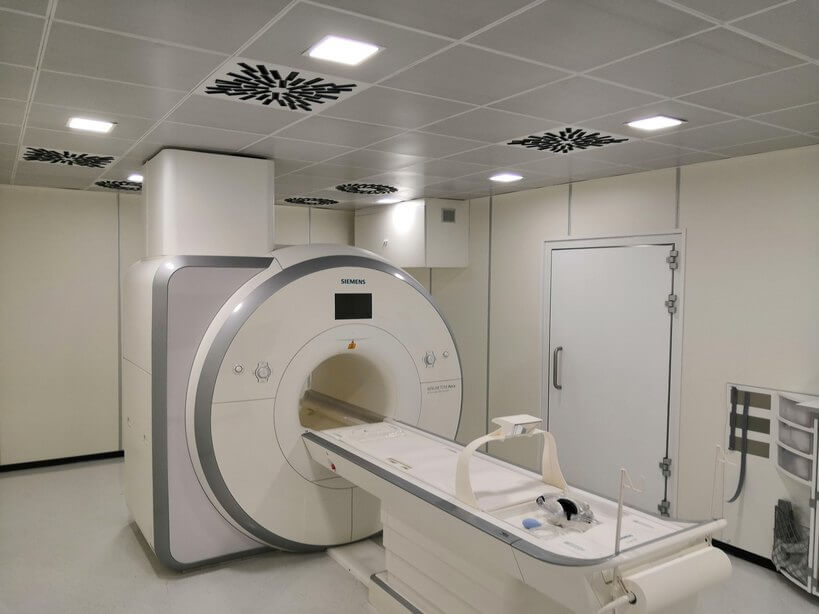
Why the choice of contractor matters
An MRI shielded room is a single-purpose piece of engineering: it either attenuates external radio-frequency energy to the scanner manufacturer's specification, or it does not. When it does not, the result is image artifacts, failed acceptance testing, delayed scanner commissioning, and expensive rework — often discovered only after the enclosure is built and the scanner is on site. Choosing the right shielding contractor is therefore one of the highest-leverage decisions in an MRI project.
The US market has a range of firms offering MRI shielding, from national specialists to general contractors who subcontract the work. The differences between them are not always visible in a proposal, so it helps to know what actually separates a reliable partner from a risky one. This guide sets out the factors worth evaluating before you sign, framed around the questions a facility should be asking.
Specialized experience with MRI, not just construction
MRI shielding is a specialized discipline distinct from general medical construction. A contractor may build excellent hospital interiors and still lack the specific expertise to design and install a Faraday cage that passes acceptance testing. Ask how many MRI enclosures the firm has completed, at what field strengths, and whether they have experience with the specific scanner make and model you are installing. A contractor who has delivered many 3T installations understands demands that a first-timer will not.
Experience also shows in how a contractor handles the two distinct shielding needs. RF shielding and magnetic shielding are different systems solving different problems, and a knowledgeable firm will discuss both correctly rather than conflating them. If a prospective contractor is vague about the distinction, or treats fringe-field containment as an afterthought, that is a warning sign.
Independent testing and performance guarantees
The only objective proof that a shielded room works is shielding effectiveness testing that confirms it meets the scanner manufacturer's attenuation specification. A credible contractor stands behind the performance of the enclosure and will commit to a tested, documented result rather than simply asserting that the room will pass.
Ask how testing is handled: whether an independent test is included, what happens if the enclosure fails the initial test, and who bears the cost of remediation. A contractor confident in their work will guarantee the shielding performance and cover corrective work needed to reach specification. Vague language about testing, or an expectation that the facility absorbs the cost of failures, tells you how much confidence the firm has in its own installation.
Compliance knowledge and trade coordination
A shielded MRI room does not exist in isolation. It has to accommodate a penetration panel for every service entering the room, integrate HVAC and ventilation, provide correct grounding and bonding, and route the quench pipe where a superconducting magnet is involved. Each of these is a point where the Faraday cage can be compromised if the shielding contractor does not coordinate closely with the electrical, mechanical, and plumbing trades.
A strong contractor understands the applicable compliance and regulatory standards and the ACR safety zoning that governs the surrounding layout, and coordinates their scope with the other trades so penetrations, seams, and interfaces are handled correctly. Ask how they manage this coordination and who is responsible for the shielding integrity at each interface. The answer reveals whether they see the enclosure as a system or just a set of panels.
Early involvement and planning support
The best outcomes come when the shielding contractor is involved early, during project planning and budgeting, rather than brought in after the room is designed. A contractor who engages early can flag structural loading for passive shielding, advise on room sizing against the scanner's fringe field, and help decide between a modular or site-built enclosure before those choices are locked in.
When evaluating firms, notice whether they ask about your building, your scanner model, and your timeline, or whether they simply quote a generic enclosure. A contractor who wants the scanner's site-planning drawings and asks about adjacencies and structure is treating the project as engineering. One who quotes a price without that information is guessing, and guesses become change orders later.
Warranty, testing history, and ongoing support
An MRI enclosure is a long-lived asset, and shielding performance can drift over time as doors wear and seams age. A contractor worth choosing offers a clear warranty, can provide references and a testing track record from comparable US installations, and supports the enclosure over its maintenance lifecycle rather than disappearing after handover.
Ask for references at facilities similar to yours, and if possible speak to a client who has worked with the contractor beyond the initial installation — through a retest, a repair, or a modification. How a firm behaves after the invoice is paid is the truest measure of its reliability. Combined with specialized experience, guaranteed testing, compliance knowledge, and early planning support, a strong post-installation record is what distinguishes a contractor you can rely on for the life of the scanner.
Frequently Asked Questions
What is the most important thing to check when choosing an MRI shielding contractor?
Specialized MRI experience combined with a guaranteed, independently tested result. The contractor should have completed comparable enclosures at your scanner's field strength, and should commit to shielding effectiveness testing that confirms the room meets the manufacturer's specification — covering the cost of any corrective work if it does not pass initially.
Can a general contractor build an MRI shielded room?
MRI shielding is a specialized discipline distinct from general medical construction. A general contractor may build excellent interiors but lack the specific expertise to design and install a Faraday cage that passes acceptance testing. If a general contractor is used, the shielding scope should be handled by an experienced MRI shielding specialist who guarantees the tested performance.
When should I bring the shielding contractor into the project?
As early as possible, during planning and budgeting rather than after the room is designed. Early involvement lets the contractor advise on structural loading, room sizing against the fringe field, penetration planning, and the choice between a modular and site-built enclosure — decisions that are far cheaper to get right before construction than to correct afterward.