
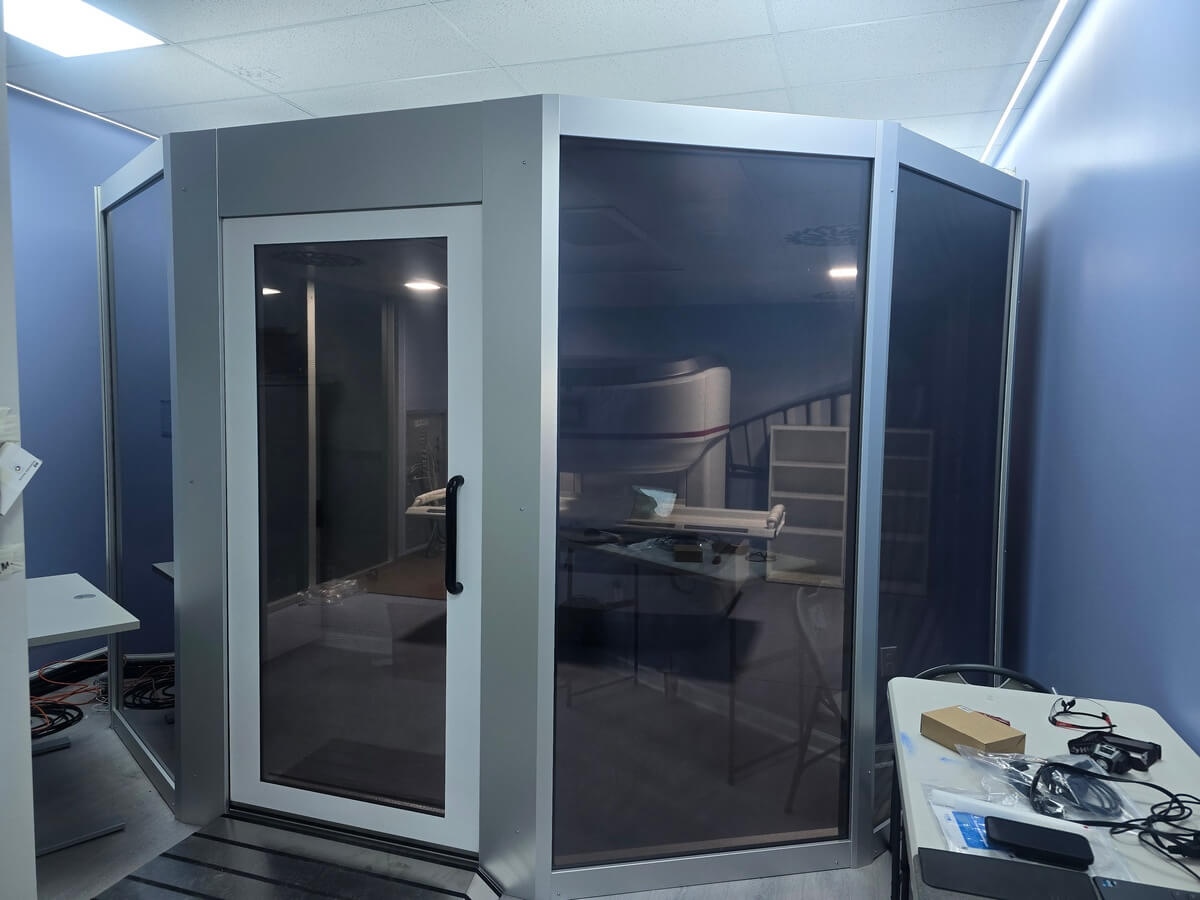
Introduction
The American College of Radiology (ACR) defines a four-zone framework for MRI facility design that has become the standard for safe MRI operations across the United States. Originally published in the ACR White Paper on MRI Safety and updated in subsequent guidance documents, the zone system establishes a progressive series of access restrictions — from the fully public entrance of the facility to the tightly controlled scanner room itself.
Understanding the four zones is essential for anyone involved in MRI room construction or renovation: architects, hospital administrators, MRI technologists, and shielding contractors all work within this framework. The zones dictate where access control points are placed, where the Faraday cage boundary begins, and how patient and staff flow is managed to prevent accidents involving the powerful magnetic field.
This guide explains each zone, the physical and administrative controls required, and how the zone model integrates with the RF shielding design of the MRI suite.
Why Safety Zones Matter
MRI scanners produce an always-on static magnetic field strong enough to turn ordinary ferromagnetic objects — oxygen tanks, wheelchairs, floor polishers, surgical instruments — into dangerous projectiles. The projectile effect is the single most common cause of serious MRI accidents and has resulted in fatalities. Beyond projectile risk, the magnetic field can interfere with implanted medical devices (pacemakers, neurostimulators, cochlear implants) with potentially life-threatening consequences.
The ACR zone system addresses these risks by creating layers of physical and procedural barriers between the general public and the magnetic field. Each successive zone adds screening, access control, and environmental safeguards. The goal is to ensure that no unscreened person or ferromagnetic object ever reaches the scanner room.
In the US, accreditation bodies such as The Joint Commission and many state health departments reference the ACR guidelines when evaluating MRI facilities. Non-compliance can result in failed inspections, loss of accreditation, and liability exposure in the event of an incident.
Zone I — Public Access
Zone I encompasses all areas of the facility that are freely accessible to the general public. This includes the building entrance, main corridors, waiting rooms, and reception areas. There are no MRI-specific restrictions in Zone I.
From a design perspective, Zone I is significant because it defines the outer boundary of the MRI safety perimeter. The transition from Zone I to Zone II must be clearly defined — either by physical separation (a door, a corridor turn, a reception desk) or by signage and administrative controls that direct individuals to stop and be screened before proceeding.
Key design consideration: the 5-gauss line of the MRI magnet's fringe field must be fully contained within Zone IV (or at minimum Zone III). The fringe field must never extend into Zone I, where unscreened members of the public could be exposed. Modern actively shielded magnets typically confine the 5-gauss line within the scanner room, but older or ultra-high-field systems may require additional passive magnetic shielding to achieve this containment.
Zone II — Supervised Access
Zone II is the interface between the public environment and the MRI-controlled area. It is supervised by MRI staff but is still accessible to patients, family members, and other non-MRI personnel. Typical Zone II areas include the MRI reception desk, patient changing rooms, and the interview/screening area where the MRI safety questionnaire is administered.
Required Controls
- MRI safety screening: every individual who will proceed beyond Zone II must complete a written screening questionnaire and a verbal interview conducted by trained MRI personnel (Level 2 MRI Personnel, as defined by the ACR).
- Ferromagnetic detection: many facilities now place ferromagnetic detection systems (FMDS) at the Zone II/III boundary as an additional safety layer, although the ACR recommends but does not yet mandate FMDS.
- Signage: clearly posted warnings indicating the presence of a strong magnetic field beyond this point and instructions to remove all metallic objects.
The screening process in Zone II is the most critical administrative control in the entire safety chain. A missed implant or undetected ferromagnetic object at this stage can lead directly to a serious incident in Zone IV.
Zone III — Restricted Access
Zone III is the strictly controlled area where free access by unscreened individuals or ferromagnetic objects poses a direct safety risk. Only individuals who have been screened in Zone II and are accompanied by or under the supervision of Level 2 MRI Personnel may enter Zone III. Physical access restrictions — locked doors, badge-controlled entry, or direct staff supervision — are required, not optional.
What Is Located in Zone III
- The MRI control room (operator console, equipment racks)
- The patient preparation/holding area immediately adjacent to the scanner room
- The equipment room (if separate from the scanner room)
- The corridor or anteroom leading to the scanner room door
The Zone III/IV Boundary
The transition from Zone III to Zone IV — typically the RF shielded door of the MRI room — is the most critical physical boundary in the facility. This is where the Faraday cage begins. The ACR recommends that this door be physically lockable or controlled to prevent unauthorized entry, and that a clear line of sight from the control room to the door be maintained so that MRI staff can visually verify who enters Zone IV.
The observation window between the control room and the scanner room serves a dual purpose: it enables patient monitoring during scans and provides visual access control of the Zone III/IV boundary.
Zone IV — The MRI Scanner Room
Zone IV is the MRI scanner room itself — the area within the Faraday cage where the magnetic field is always present and the RF shielding enclosure is active. This is the highest-risk area in the facility and has the most stringent access requirements.
Zone IV Requirements
- Access: only fully screened patients (accompanied by Level 2 MRI Personnel) and MRI-trained staff may enter. No exceptions.
- Ferromagnetic exclusion: no ferromagnetic objects may enter Zone IV under any circumstances. This includes seemingly innocuous items like pens, hairpins, name badges, and cleaning equipment. MRI-safe (labeled MR Safe or MR Conditional per ASTM standards) equipment must be used for everything inside the room.
- Emergency protocols: quench procedures, cardiac arrest protocols (requiring non-ferromagnetic resuscitation equipment), and fire response plans must be specific to the Zone IV magnetic environment.
- RF shielding: the Faraday cage must achieve the Shielding Effectiveness specified by the MRI manufacturer, with all penetrations (door, window, HVAC waveguides, penetration panels) tested and certified.
The physical boundary of Zone IV is defined by the Faraday cage itself. The RF shielded walls, floor, ceiling, door, and window form both the electromagnetic barrier and the safety perimeter. This is why the shielding contractor must work in close coordination with the MRI safety officer and architect — the cage is simultaneously an engineering structure and a safety boundary.
How RF Shielding Integrates with the Zone Model
The ACR zone framework and the RF shielding design of an MRI suite are inseparable. The Faraday cage defines the Zone IV boundary, and every component of the shielding system plays a role in the safety architecture:
- The RF shielded door is the Zone III/IV access control point. Its physical lock or access control mechanism is a safety device, not just a convenience feature.
- The observation window enables visual surveillance from Zone III into Zone IV — a core ACR requirement for patient monitoring and access verification.
- Penetration panels allow electrical and data connections to pass from Zone III (control room) into Zone IV without breaching the RF barrier or the safety perimeter.
- HVAC waveguides maintain both RF integrity and the physical separation between Zone III and Zone IV for air handling.
When planning a new MRI suite, the zone layout should be established before the shielding design is finalized. The location of the RF door, observation window, and penetration panel all follow from the zone transitions and the required patient/staff flow patterns.
Common Compliance Issues
Even well-designed MRI facilities can develop zone compliance problems over time. The most frequently cited issues during accreditation surveys include:
- Unlocked Zone III doors: the door between Zone II and Zone III is propped open or the badge reader is disabled for convenience. This eliminates the physical access barrier that the ACR requires.
- Incomplete screening: patients or staff bypass the Zone II screening process due to time pressure or familiarity ("I've been scanned before"). Every entry to Zone III/IV requires fresh screening.
- Ferromagnetic objects in Zone IV: non-MR-safe equipment (standard IV poles, oxygen tanks, fire extinguishers, cleaning carts) stored or used in the scanner room.
- Fringe field extending beyond Zone IV: the 5-gauss line reaching into Zone III corridors or — worse — into Zone II or Zone I areas. This requires re-evaluation of magnetic shielding or scanner placement.
- Degraded RF door performance: worn seals on the RF shielded door reducing SE and, at the same time, weakening the physical barrier between Zone III and Zone IV.
A regular internal audit of zone compliance — combined with annual SE testing of the Faraday cage — is the best way to catch and correct these issues before they become accreditation findings or, worse, patient safety incidents.
Frequently Asked Questions
What are the four MRI safety zones?
The ACR defines four zones: Zone I is the public access area (lobbies, corridors). Zone II is the supervised screening area where patients complete MRI safety questionnaires. Zone III is the restricted area (control room, preparation areas) accessible only to screened individuals under MRI staff supervision. Zone IV is the MRI scanner room itself, inside the Faraday cage, where the magnetic field is always active.
Are ACR MRI safety zones legally required in the US?
The ACR guidelines are not federal law, but they are referenced by accreditation bodies (The Joint Commission, ACR accreditation programs) and many state health departments. Failure to comply can result in loss of accreditation, failed inspections, and significant liability exposure in the event of an MRI safety incident. In practice, compliance with the ACR zone framework is considered the standard of care for MRI facilities in the United States.
Where does the Faraday cage fit in the zone model?
The Faraday cage (RF shielding enclosure) defines the physical boundary of Zone IV — the MRI scanner room. The RF shielded door is the controlled access point between Zone III and Zone IV. The observation window provides the required visual link from Zone III into Zone IV for patient monitoring and access verification.
What is a ferromagnetic detection system (FMDS)?
A ferromagnetic detection system is a screening device — similar in concept to an airport metal detector but specifically calibrated for ferromagnetic materials — typically placed at the Zone II/III or Zone III/IV boundary. It provides an additional safety layer to catch ferromagnetic objects that may have been missed during the manual screening process. The ACR recommends FMDS use but does not currently mandate it.
Who is classified as Level 2 MRI Personnel?
Level 2 MRI Personnel are individuals who have undergone MRI safety training beyond standard orientation and are authorized to independently screen patients, supervise access to Zone III and Zone IV, and respond to MRI safety emergencies. This typically includes MRI technologists, MRI radiologists, and MRI physicists. The ACR requires that at least one Level 2 individual be present whenever Zone IV is occupied.