
Introduction
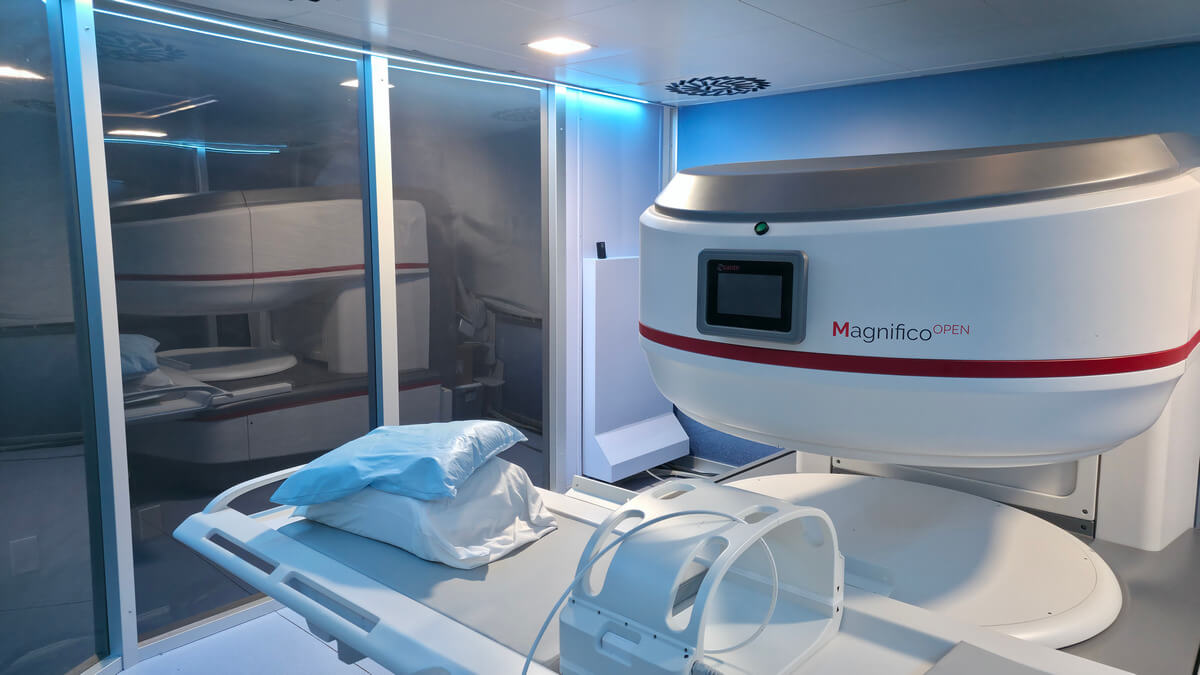
The observation window is the primary visual link between the MRI control room and the scanner suite. Technologists rely on it to monitor patients throughout every scan — making it essential for both safety and workflow. At the same time, the window is an opening in the Faraday cage, and any opening is a potential path for RF leakage.
A properly engineered MRI observation window must deliver clear visibility while matching the Shielding Effectiveness (SE) of the surrounding enclosure. This guide explains the two main shielded glass technologies, key selection criteria, and installation considerations.
Why Standard Glass Cannot Be Used
Ordinary glass is an electrical insulator — it does not conduct current and cannot block radiofrequency energy. Installing a plain glass pane in a Faraday cage wall would create an unshielded hole equivalent to having no wall at all in that area. Even a small unshielded aperture can reduce the room's SE by tens of decibels, allowing external interference to reach the MRI scanner and degrading image quality.
MRI observation windows solve this by incorporating a conductive layer within or on the glass that maintains the electromagnetic barrier while remaining optically transparent.
Shielded Glass Technologies
Copper Mesh Laminated Glass
The traditional and most widely used technology. A fine copper wire mesh (typically 40–80 wires per inch) is laminated between two or more glass panes. The mesh is electrically bonded to the window frame, which in turn connects to the Faraday cage. The mesh blocks RF energy while the small apertures between wires remain well below the cutoff size for the frequencies of interest.
- SE performance: 80–100+ dB depending on mesh density and frequency range
- Optical clarity: the mesh is visible as a faint grid pattern, especially at close range or under certain lighting angles. This does not impair patient monitoring but is noticeable.
- Durability: excellent — the mesh is protected within the laminate and does not degrade under normal conditions
- Cost: moderate, well-established supply chain
Conductive Coated Glass
A newer alternative where a thin transparent conductive coating — typically indium tin oxide (ITO) or a metallic sputter layer — is applied to the glass surface. The coated surface is electrically connected to the window frame and Faraday cage. Because the coating is a continuous thin film rather than a wire grid, it provides a clearer view without the visible mesh pattern.
- SE performance: 60–80 dB typical; achieving 100+ dB with coatings alone is difficult
- Optical clarity: superior — no visible pattern, similar to a standard glass pane
- Durability: good, though coatings can be scratched if not protected; usually the coated surface faces the laminate interior
- Cost: higher than mesh, especially for large panels with high SE requirements
Hybrid (Mesh + Coating)
Some high-end installations use a combination: a coarser mesh for primary attenuation plus a conductive coating to fill any micro-gaps. This can achieve the highest SE values (100+ dB) with improved optical clarity compared to a dense mesh alone.
How to Choose the Right Window
Selecting an MRI observation window involves balancing four factors:
1. Required Shielding Effectiveness
The window must meet the SE specification set by the MRI manufacturer — typically the same as the wall specification or within 5 dB. For most 1.5T and 3T installations requiring 80–100 dB, copper mesh glass is the standard choice. Facilities that prioritize aesthetics and can accept slightly lower SE values may consider conductive coated glass.
2. Window Size
Larger windows provide better patient visibility but are more expensive and structurally demanding. Typical MRI observation windows range from 800 × 500 mm to 1500 × 900 mm. The window frame must be structurally integrated into the Faraday cage wall with continuous conductive bonding — larger windows require heavier frames and more robust mounting.
3. Optical Clarity vs. SE Trade-off
Denser copper mesh provides higher SE but reduces light transmission and makes the grid more visible. Coarser mesh or conductive coatings improve clarity but may sacrifice SE. Discuss priorities with the shielding contractor to find the right balance for your facility's clinical workflow.
4. Lead Shielding (If Required)
In facilities where the MRI room may also be used for procedures involving ionizing radiation (e.g., MRI-guided interventions), the observation window may need to incorporate lead glass for X-ray protection in addition to RF shielding. Lead-glass RF windows are available but significantly heavier and more expensive.
Installation and RF Bonding
Even the highest-quality shielded glass will fail if the window is not properly bonded to the Faraday cage. Key installation requirements include:
- Continuous frame contact: the window frame must make unbroken electrical contact with the cage wall panels on all four sides. This is typically achieved with conductive gaskets compressed between the frame and the wall shielding layer.
- Mesh-to-frame bonding: the copper mesh (or conductive coating edge) must connect to the frame with a low-resistance joint — usually soldered or clamped with conductive tape under pressure.
- No sealant gaps: non-conductive silicone or caulk used for weatherproofing must not bridge the conductive path. Sealant is applied outboard of the RF contact zone.
- Mounting hardware: all fasteners must be non-ferromagnetic (stainless steel or brass), and bolt patterns must maintain seal compression evenly around the perimeter.
After installation, the window area is tested as part of the overall SE certification of the room. Any gap or poor bond at the frame will appear as a localized SE drop during testing.
Maintenance Tips
Observation windows require less maintenance than RF doors because they have no moving parts, but they should not be neglected:
- Clean glass regularly with non-abrasive glass cleaner. Avoid scraping or scratching the interior surface, especially on conductive-coated windows.
- Inspect the frame gaskets annually for compression loss, corrosion, or visible gaps. Re-torque frame bolts if the gasket has settled.
- Check for condensation between laminated panes — moisture trapped inside the laminate can indicate a seal failure and may eventually corrode the copper mesh.
- Include the window in annual SE spot checks to verify performance has not degraded.
Frequently Asked Questions
What is an MRI observation window made of?
An MRI observation window consists of two or more glass panes with an RF shielding layer between them — either a fine copper wire mesh or a transparent conductive coating (such as indium tin oxide). The shielding layer is electrically bonded to the window frame and the surrounding Faraday cage to maintain electromagnetic continuity.
Can you see clearly through a shielded MRI window?
Yes. Copper mesh windows have a faint grid pattern visible at close range but do not impair patient monitoring at normal viewing distances. Conductive coated glass provides even clearer visibility, comparable to standard glass. Both types allow adequate light transmission for control room operations.
How large can an MRI observation window be?
Typical sizes range from 800 × 500 mm to 1500 × 900 mm. Larger custom sizes are possible but require heavier frames, more robust mounting into the Faraday cage wall, and may be more expensive. The maximum practical size depends on the wall structure, SE requirements, and shielding contractor capabilities.
Does the observation window affect the room's Shielding Effectiveness?
A properly installed shielded window matches or closely approaches the SE of the surrounding walls — typically 80–100 dB. However, a poorly bonded frame or damaged mesh can create a localized weak point. The window area is always included in the SE certification test to verify performance.