
Field strength choices in veterinary imaging
Veterinary practices adopting MRI face an early decision that shapes the entire shielding project: the magnet field strength of the scanner. Veterinary imaging spans a wider range of field strengths than human clinical MRI, from low-field permanent-magnet systems around 0.2 to 0.4 tesla up to high-field superconducting scanners at 1.5 tesla and above. Each end of this range carries different shielding implications, and understanding them early helps a practice plan a room that matches the scanner it intends to install.
Field strength affects two distinct shielding concerns. The first is RF shielding — the Faraday cage that blocks external radio-frequency interference — which every scanner requires regardless of field strength. The second is magnetic containment, the management of the static fringe field that surrounds the magnet, which becomes more demanding as field strength rises. The relationship between these two is often misunderstood, so it is worth separating them clearly.
Low-field systems: smaller footprint, still shielded
Low-field veterinary scanners, typically permanent-magnet or resistive designs, are popular in specialty practices because of their lower purchase cost, simpler siting, and absence of cryogen requirements. Their static fringe field is comparatively small, so the 5-gauss safety boundary is often contained within or very close to the scanner itself, which reduces or eliminates the need for passive magnetic shielding of the surrounding walls.
However, a smaller fringe field does not mean RF shielding can be skipped. Low-field systems still detect weak RF signals and remain vulnerable to external interference. In fact, because the received signal is weaker at low field, image quality can be especially sensitive to EMI and RFI sources in the surrounding environment. A properly designed and tested Faraday cage remains essential. The practical benefit of low field is mainly in reduced magnetic containment requirements and a smaller, lighter installation, not in avoiding RF shielding.
High-field systems: stronger fringe field, greater demands
High-field superconducting scanners at 1.5 tesla deliver faster scans and higher image resolution, which is why referral hospitals and larger specialty centers often choose them. The trade-off is a substantially larger static fringe field. The 5-gauss line can extend several meters from the magnet, which raises the likelihood that passive magnetic shielding — heavy carbon steel in the walls, floor, or ceiling — will be needed to keep the field contained within controlled areas.
These scanners also use superconducting magnets cooled by cryogens, which introduces requirements that low-field systems avoid: a quench pipe to vent helium safely in an emergency, and the associated penetrations through the shielded enclosure. The RF shielding must be engineered to a tight specification because high-field scanners are demanding about image quality, and the overall project carries more weight, more penetrations, and more structural coordination than a low-field installation.
Siting and structural considerations
Field strength strongly influences where a scanner can be sited within a veterinary building. A low-field system's modest weight and small fringe field give it flexibility to fit into rooms that a high-field magnet could not occupy without significant structural work. High-field systems demand verified floor loading for the magnet and any passive shielding, careful attention to adjacent spaces that fall within the fringe field, and coordination with the building structure from the earliest design stage.
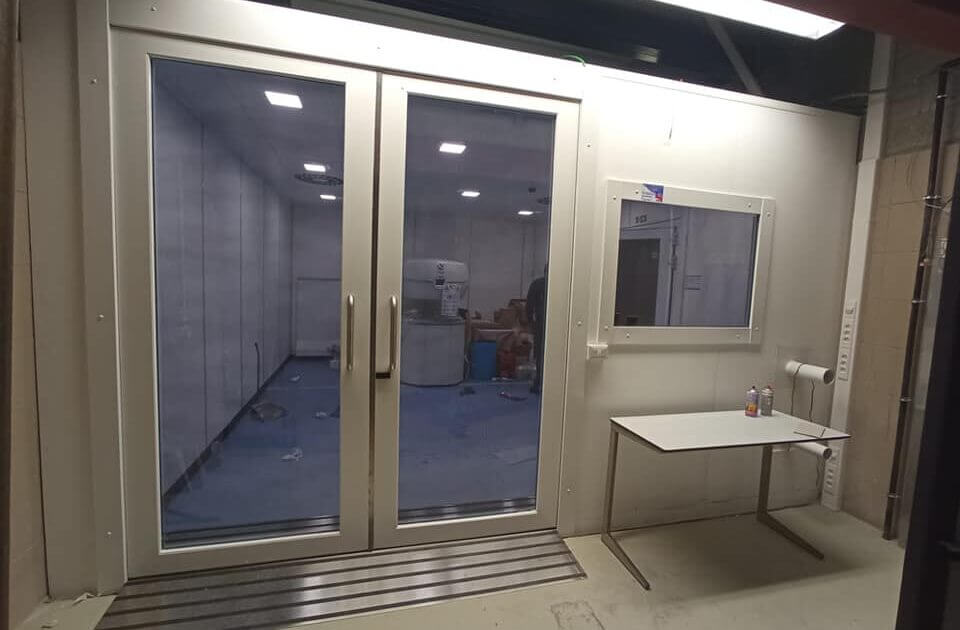
For many veterinary practices working within an existing building, a modular Faraday cage provides the adaptability to fit the shielded room into the available space at either field strength. The difference is that a high-field installation layers magnetic containment and cryogen infrastructure on top of the RF enclosure, whereas a low-field installation is often predominantly an RF shielding project.
Matching the scanner to the practice
The right field strength depends on the clinical caseload, the building, and the budget — not on shielding alone. But because shielding cost and complexity scale with field strength, they belong in the decision from the start. A practice choosing a low-field system should budget for a full RF enclosure and testing, but can often avoid heavy magnetic shielding. A practice choosing high field should plan for RF shielding, likely magnetic containment, cryogen venting, and the structural work these entail.
The most reliable way to avoid surprises is to bring the shielding engineer into the conversation alongside the scanner vendor before the system is selected, and to fold shielding into the overall project planning and budget. Whatever field strength is chosen, the completed enclosure should undergo shielding effectiveness testing to confirm it meets the scanner manufacturer's specification before the system goes into clinical use.
Frequently Asked Questions
Do low-field veterinary MRI systems still need a Faraday cage?
Yes. Every MRI, regardless of field strength, detects weak RF signals and needs a Faraday cage to block external interference. Because the received signal is weaker at low field, image quality can be especially sensitive to environmental RF, so a properly designed and tested RF enclosure remains essential even when magnetic shielding needs are minimal.
Why does high-field MRI often require magnetic shielding when low-field does not?
The static fringe field grows with magnet field strength. A high-field 1.5T scanner can push its 5-gauss safety line several meters from the magnet, often beyond controlled areas, which requires passive magnetic shielding to contain it. A low-field system's much smaller fringe field is frequently contained within or near the scanner itself, reducing or eliminating that need.
Which field strength is easier to install in an existing veterinary building?
Low-field systems are generally easier to site because of their lighter weight, smaller fringe field, and absence of cryogen infrastructure. High-field systems require verified floor loading, likely magnetic containment, and a quench pipe, which add structural and space demands. The best choice still depends on the clinical needs and budget, not siting alone.