
Why mobile and relocatable MRI exist
Not every MRI is installed permanently in a hospital building. Mobile MRI units mounted in trailers travel between sites to provide imaging where a fixed scanner would be underused, and relocatable modular units offer semi-permanent capacity that can be moved or expanded as a facility's needs change. Both approaches let a healthcare provider add MRI capability quickly, bridge a gap during construction, or serve multiple locations with a single scanner.
Whatever the format, the physics is unchanged. The scanner still detects extremely weak radio-frequency signals and still needs a complete Faraday cage around it. What differs from a fixed installation is how that shielded enclosure is built, how it copes with movement, and how the space connects to the host building. These differences are what make mobile and relocatable shielding a specialized discipline.
The shielded enclosure in a mobile trailer
In a mobile MRI trailer, the RF shielded enclosure is integrated into the trailer body itself during manufacture. The walls, floor, and ceiling of the scanner compartment form the Faraday cage, and the shielding must remain effective despite the vibration, flexing, and temperature swings that come with over-the-road transport. This is a more demanding structural environment than a building, where the shielded room sits on a stable foundation and never moves.
Seams, the shielded door, and any windows must be engineered to maintain RF integrity through repeated travel. The same principles that govern a fixed enclosure — continuous conductive surfaces, properly sealed joints, and filtered penetrations — apply, but they are implemented in a structure designed to be driven down a highway. Penetrations for power, cooling, and the cryogen quench pipe all have to pass through the trailer envelope without compromising the cage.
Docking and site interface
When a mobile unit arrives at a site, it docks against the host building so patients and staff can move between the building and the scanner. This docking interface is a critical shielding boundary. The connection between the trailer and the building must preserve the Faraday cage where the two meet, so that the seam created at the door or vestibule does not become a leakage path for external RF.
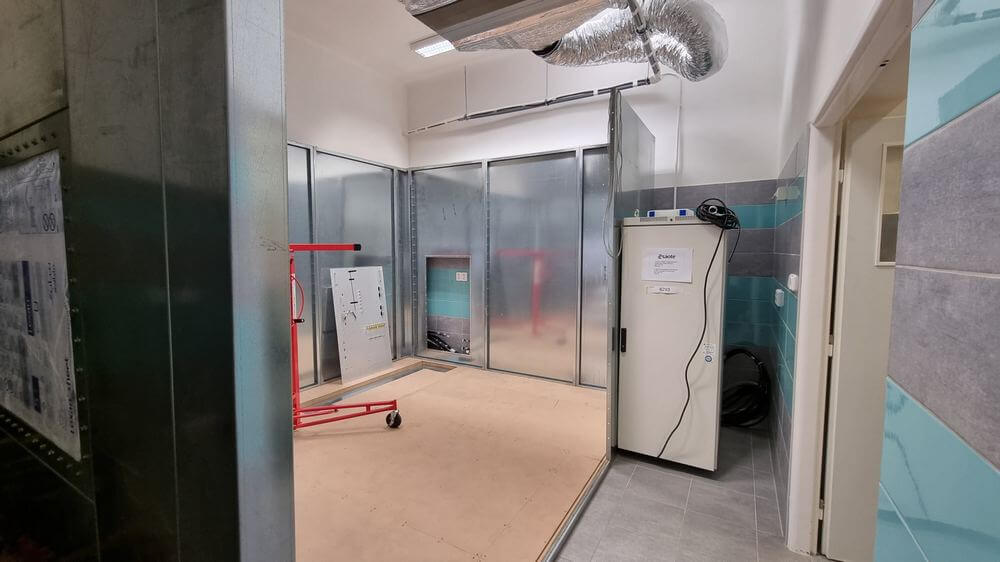
Relocatable modular units face a related challenge. Because they are assembled from prefabricated sections and may be reconfigured or moved, the joints between modules are engineered as maintainable RF seams rather than permanent welds. This shares design DNA with the modular Faraday cage used in fixed sites, but with added emphasis on the interfaces that allow the unit to be relocated or connected to different host buildings over its life.
Siting, fringe field, and the surrounding environment
A mobile or relocatable MRI still produces a static fringe field, and the 5-gauss safety line still has to be respected at every site where the unit operates. Because the surroundings change from one location to another, siting has to be assessed for each parking or placement position: what is above and below, how close the public can approach, and whether nearby structures contain steel that could distort the field or be affected by it.
The external RF environment also changes with each site. A location near broadcast transmitters, heavy electrical equipment, or other EMI and RFI sources may challenge the enclosure in ways a quieter site does not. Because the shielding travels with the unit rather than being built for one fixed environment, it has to perform across the full range of conditions the unit will encounter.
Testing and ongoing verification
Like any MRI enclosure, a mobile or relocatable unit must pass shielding effectiveness testing to confirm it meets the scanner manufacturer's specification. The difference is that the movement inherent to these units makes ongoing verification more important. Vibration and flexing over time can loosen seams or degrade the shielded door, so periodic retesting is a sensible part of the maintenance lifecycle for a traveling scanner.
For docked mobile units, the integrity of the building interface should be confirmed after docking, since that seam is re-made each time the unit connects to a site. Building this verification into the operational routine protects image quality and catches shielding degradation before it affects clinical scans. A mobile MRI that is tested only once, at manufacture, does not account for the wear that travel inevitably introduces.
Frequently Asked Questions
Does a mobile MRI trailer need the same RF shielding as a fixed installation?
Yes. The scanner detects the same weak RF signals regardless of whether it is in a building or a trailer, so a complete Faraday cage is required. In a mobile unit the enclosure is integrated into the trailer body and engineered to stay effective through the vibration and flexing of road transport, which a fixed room never experiences.
How is the shielding maintained where a mobile unit connects to a building?
The docking interface between the trailer and the host building is a critical shielding boundary. The connection must preserve the Faraday cage where the two meet so the seam does not become an RF leakage path. Because this seam is re-made each time the unit docks, its integrity should be verified after connecting to a site.
Does a relocatable MRI need to be re-checked when it moves to a new site?
Yes. The fringe field and external RF environment differ at every location, so siting and the 5-gauss safety line must be assessed for each placement. Because vibration and repeated assembly can affect seams over time, periodic shielding retesting is a sensible part of the maintenance routine for relocatable and mobile units.