
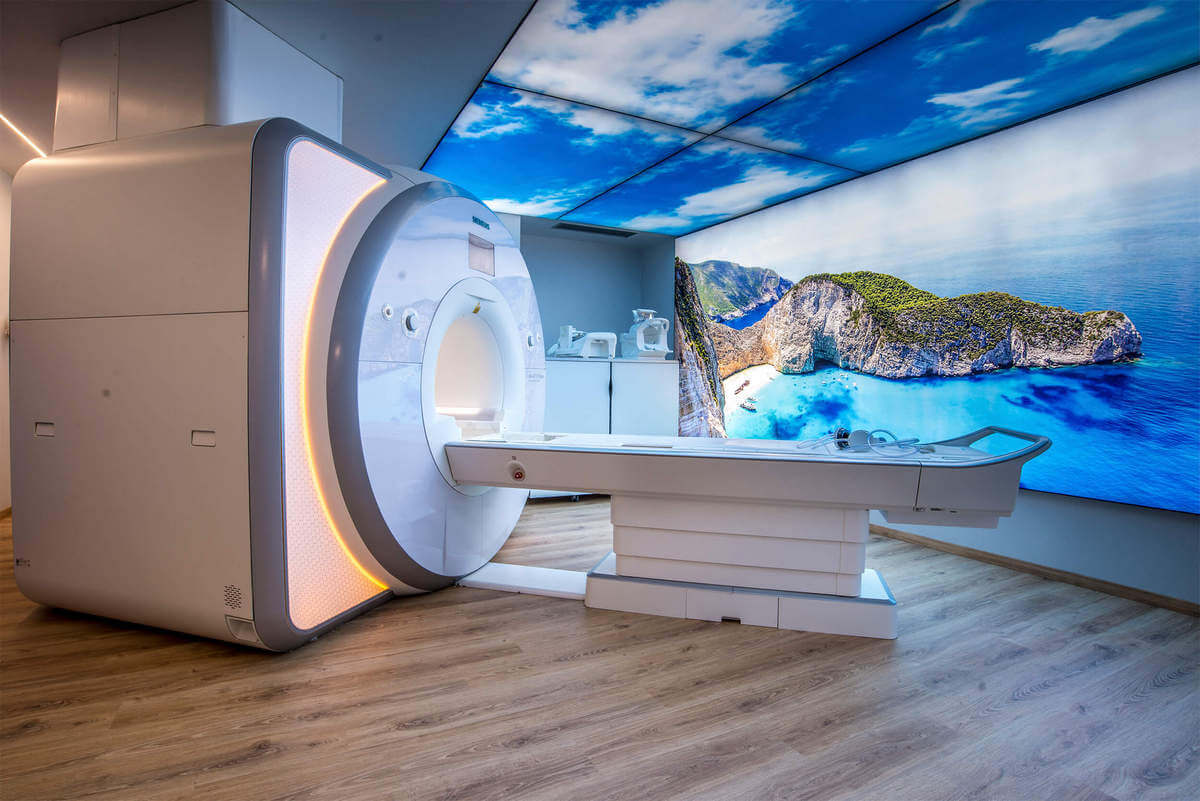
Why MRI Suites Are So Loud
MRI scanners are among the loudest pieces of medical equipment in any hospital. During a scan, the gradient coils inside the magnet switch rapidly to create the spatial encoding needed for image formation. These coils carry high currents within a powerful static magnetic field, and the resulting Lorentz forces cause them to vibrate — producing intense acoustic noise that can exceed 110 dB(A) in the bore of a 3T scanner. For reference, that is louder than a rock concert and approaches the threshold of pain.
This noise is not merely an annoyance. It creates genuine clinical challenges: patient anxiety and motion artifacts (especially in pediatric and claustrophobic patients), difficulty communicating between the technologist and the patient, potential hearing damage during prolonged examinations, and regulatory compliance requirements that mandate hearing protection. Addressing acoustic noise is an integral part of MRI suite design that intersects directly with the room construction and Faraday cage design.
Sources of Acoustic Noise in the MRI Environment
The dominant noise source is the gradient coil system. Each time the scanner switches a gradient, the coil assembly vibrates against its mounting structure and the magnet bore tube, transmitting sound both into the bore (where the patient lies) and outward into the scan room. The frequency content and intensity of the noise depend on the pulse sequence being run — echo planar imaging (EPI) sequences used in functional MRI are notoriously loud, while standard spin-echo sequences are quieter.
Secondary noise sources include the cryocooler (cold head) that maintains the superconducting magnet at operating temperature, producing a rhythmic mechanical hum; the HVAC system that maintains temperature and air quality in the scan room; and the chilled water pumps and gradient amplifier cooling fans located in the equipment room. While individually less intense than gradient noise, these background sources contribute to the overall acoustic environment and can be particularly noticeable during the quiet intervals between scan sequences.
Sound transmission paths matter as much as sources. Noise generated inside the scan room can travel through the walls, floor, and ceiling to adjacent spaces — including patient recovery areas, exam rooms, and offices — where it creates a disturbance that affects workflow and patient experience throughout the department.
How RF Shielding Interacts with Room Acoustics
The Faraday cage that provides RF shielding has a significant — and often counterproductive — effect on room acoustics. A shielded enclosure is, by design, a sealed metal box. Metal surfaces are highly reflective to sound waves, and the enclosed volume creates a reverberant space that amplifies and sustains noise rather than absorbing it.
In an unshielded room of similar dimensions, drywall, ceiling tile, and carpeting provide natural acoustic absorption that reduces reverberation. Inside a Faraday cage, these conventional absorptive finishes are either absent or replaced by RF-compatible alternatives that may not provide the same acoustic performance. The result is that an MRI room often sounds louder and harsher than the same space would without shielding, even though the actual sound power output of the scanner is unchanged.
This means acoustic treatment must be planned as part of the shielding design — not as an afterthought. Every material placed inside the shielded enclosure must be evaluated for both its acoustic properties and its RF compatibility. Materials that contain metallic fibers, conductive backings, or ferromagnetic components are unsuitable, regardless of their acoustic performance, because they can compromise shielding effectiveness or create safety hazards in the magnetic field.
Soundproofing Strategies Compatible with RF Shielding
Effective acoustic treatment in an MRI suite operates on two fronts: reducing noise within the scan room (for patient comfort) and preventing noise transmission to adjacent spaces (for departmental workflow).
Interior acoustic absorption: Specialized MRI-compatible acoustic panels can be mounted on the walls and ceiling inside the shielded enclosure. These panels use non-metallic, non-ferromagnetic absorptive materials — typically fiberglass, mineral wool, or melamine foam — with RF-transparent fabric facings. They reduce reverberation time and lower the perceived noise level inside the room without affecting shielding performance. Panel placement should prioritize the surfaces closest to the patient — the walls flanking the scanner and the ceiling above the bore.
Bore liner treatments: Some manufacturers offer acoustic bore liners or gradient coil encapsulation systems that reduce noise at the source by damping the vibration of the gradient assembly before it couples into the bore tube. These are scanner-specific solutions that can achieve noise reductions of 10 to 30 dB depending on the design and the pulse sequence.
Sound transmission control: Preventing scanner noise from reaching adjacent spaces requires mass and decoupling in the room construction. The shielded enclosure itself provides some transmission loss due to its metal panels, but flanking paths through the RF door, the observation window, HVAC penetrations, and structural connections can undermine this isolation. Acoustic seals at the door perimeter, laminated glass in the observation window, and lined ductwork at HVAC penetrations all contribute to controlling these flanking paths.
Patient-Facing Noise Reduction Measures
Even with optimized room acoustics, the noise level inside the scanner bore during active sequences will remain high enough to require hearing protection for every patient. Standard practice includes disposable foam earplugs (NRR 29–33 dB), MRI-compatible over-ear headphones (which also allow music playback and technologist communication), or a combination of both for the highest attenuation.
Beyond hearing protection, patient communication systems play a critical role in comfort and scan quality. Modern MRI-compatible intercom systems use noise-canceling microphones and pneumatic or fiber-optic audio delivery to maintain clear two-way communication despite the ambient noise. Some systems include active noise cancellation (ANC) that samples the gradient noise in real time and generates an anti-phase signal to reduce the perceived volume inside the headphones.
Patient anxiety related to scanner noise is a significant contributor to motion artifacts and scan failures, particularly in pediatric, elderly, and claustrophobic populations. Facilities that invest in comprehensive noise management — combining room acoustics, hearing protection, communication systems, and patient coaching — report measurably lower sedation rates, fewer repeat scans, and higher patient satisfaction scores. These operational benefits often justify the incremental investment in acoustic treatment during the initial project planning and budgeting phase.
Acoustic Design Checklist for MRI Suite Projects
Integrating acoustic planning into an MRI suite project from the beginning avoids costly retrofits and ensures the best outcome for patients, staff, and adjacent occupants. The following checklist covers the key acoustic considerations that should be addressed during the design phase:
Room layout: Position the MRI suite away from noise-sensitive adjacencies whenever possible. Place the equipment room, which houses gradient amplifiers and cooling systems, on the opposite side of the scan room from patient areas. Use buffer spaces (control room, storage) between the scan room and public corridors.
Wall and ceiling construction: Specify sufficient mass and decoupling in the room-in-room construction to achieve the target Sound Transmission Class (STC) rating for adjacent occupancies. Coordinate with the shielding contractor to ensure acoustic layers do not interfere with RF enclosure continuity.
Interior finishes: Specify MRI-compatible acoustic panels for walls and ceiling inside the enclosure. Confirm that all materials are non-ferromagnetic and RF-transparent. Target a reverberation time (RT60) below 0.6 seconds in the finished room.
Door and window: Specify acoustic seals on the RF door and laminated or double-pane glass in the observation window. Verify acoustic performance ratings from the shielding manufacturer.
HVAC: Design ductwork with lined plenums and silencers at the point of entry into the shielded enclosure. Limit duct-borne noise to NC-35 or lower at the room diffuser. Refer to HVAC ventilation guidelines for additional detail.
Patient systems: Include MRI-compatible headphones with music playback, a noise-canceling intercom, and a stock of high-NRR earplugs in the equipment specification.
Frequently Asked Questions
How loud is an MRI scanner during a scan?
MRI scanners typically produce noise levels between 85 and 115 dB(A) during active scanning, depending on the field strength, scanner model, and pulse sequence. A 3T scanner running an echo planar imaging (EPI) sequence can exceed 110 dB(A) in the bore — louder than a rock concert. All patients are required to wear hearing protection during every MRI examination.
Can acoustic panels be installed inside an MRI Faraday cage?
Yes, but the panels must be made from MRI-compatible materials — non-metallic, non-ferromagnetic, and RF-transparent. Fiberglass, mineral wool, and melamine foam panels with fabric facings are commonly used. Any material containing metallic fibers, conductive backings, or ferromagnetic components is unsuitable because it can compromise RF shielding effectiveness or create safety hazards in the magnetic field.
Does the Faraday cage make the MRI room louder?
Yes, the Faraday cage tends to increase perceived noise levels inside the scan room. The sealed metal enclosure creates a highly reverberant space that reflects and sustains sound rather than absorbing it. Without acoustic treatment, the reverberation time inside a shielded room is significantly longer than in a conventional room of the same size, making the scanner noise sound louder and harsher.
What is the best way to reduce MRI noise for patients?
The most effective approach combines multiple strategies: acoustic absorptive panels on the walls and ceiling inside the shielded room to reduce reverberation, high-NRR foam earplugs for every patient, MRI-compatible over-ear headphones with music playback, and a noise-canceling intercom system for technologist communication. Some scanner manufacturers also offer acoustic bore liners that reduce noise at the source by 10 to 30 dB.