
Introduction
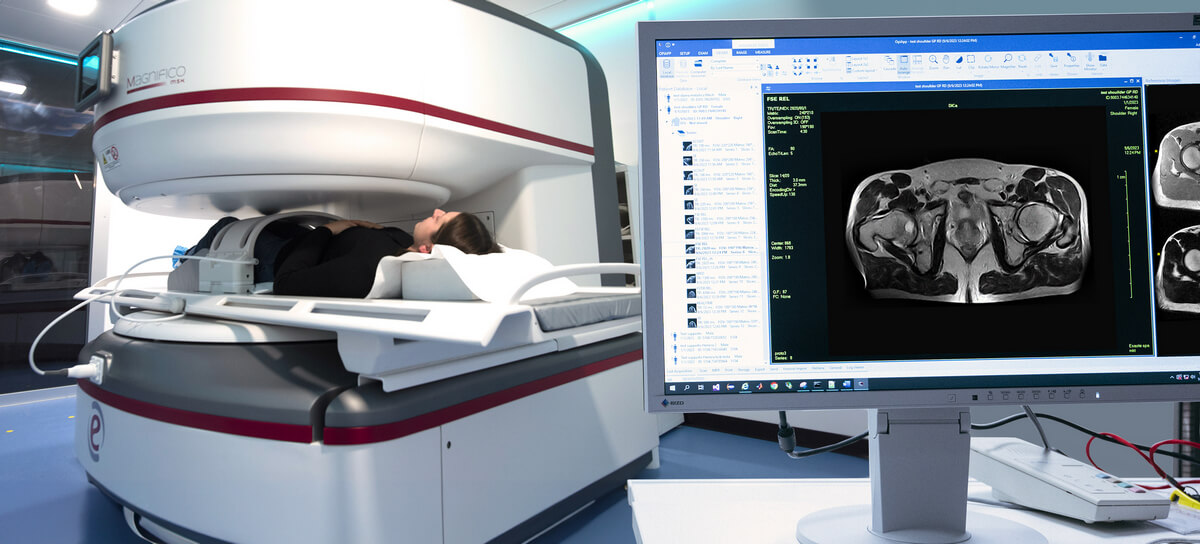
Interventional MRI (iMRI) and intraoperative MRI suites use real-time or near-real-time MRI imaging to guide surgical and interventional procedures — from neurosurgery and tumor resection to biopsies, ablations, and cardiac catheterization. These suites place fundamentally different demands on the Faraday cage compared to diagnostic MRI installations.
The core challenge: a diagnostic MRI room is designed to keep everything out — sealed tight, minimal penetrations, controlled access. An interventional suite must do the same while also allowing surgical teams, equipment, and workflows to move efficiently in and out of the shielded space, often during active imaging. This tension between RF integrity and clinical workflow drives every design decision.
Common iMRI Suite Configurations
Single-Room (Scanner in the OR)
The MRI scanner is permanently installed in the operating room, which is enclosed in a Faraday cage. The surgical team works around the scanner, and imaging is performed with the patient in position on the surgical table. This configuration offers the fastest scan-to-surgery cycle but requires that all surgical equipment be MRI-compatible and that the entire OR be shielded.
Dual-Room (Shared Scanner)
The MRI scanner sits in a shielded room adjacent to one or two operating rooms. When imaging is needed, the patient (on a specialized transfer table) moves from the OR into the MRI room through a wide RF shielded door or sliding partition. This is the most common configuration for intraoperative neurosurgery. The MRI room functions as a diagnostic suite when not supporting surgery.
Mobile/Ceiling-Mounted Scanner
The scanner moves to the patient rather than the patient moving to the scanner. A ceiling-mounted rail system carries the magnet from a shielded parking position into the OR for imaging, then retracts it for surgery. The OR itself must be fully shielded because the scanner operates within it, but the shielding needs are intermittent — which introduces unique door and access requirements.
How iMRI Shielding Differs from Diagnostic
Larger and More Frequent Door Openings
Diagnostic MRI rooms have one standard-size RF door that opens a few times per patient. iMRI suites may need double-wide doors (for patient bed transfer), sliding RF partitions (for dual-room configurations), or multiple doors (for separate surgical team and patient access). Each door is a potential SE weak point, and the frequent opening/closing cycles during procedures increase mechanical wear on seals and contacts.
Higher Penetration Count
Surgical suites require far more signal and utility lines through the Faraday cage than diagnostic rooms: anesthesia gas supply, surgical suction, additional electrical circuits for MRI-compatible surgical instruments, fiber-optic video feeds, and patient monitoring beyond what a diagnostic installation requires. Each penetration must be filtered or waveguide-attenuated at the penetration panel, and the panel itself may need to be significantly larger.
Surgical Lighting and Equipment
Standard surgical lights generate EMI that would degrade MRI image quality. iMRI suites use MRI-compatible LED surgical lights with filtered power supplies. All equipment that enters the shielded room during imaging — monitors, IV pumps, anesthesia machines — must be MR Conditional, and each piece adds to the EMI management challenge.
Environmental Control
Operating rooms have more demanding HVAC requirements than diagnostic MRI rooms: higher air exchange rates, positive pressure for sterile environments, and precise temperature and humidity control for patient safety during surgery. These requirements mean larger ductwork penetrating the Faraday cage, requiring larger waveguides that must still maintain RF attenuation.
Key Design Considerations
- SE margin: because iMRI suites have more penetrations, more door openings, and more in-room equipment than diagnostic installations, designing with additional SE margin (5–10 dB above the scanner manufacturer's minimum) provides a buffer against the cumulative effect of these factors.
- Door specification: the RF door is the critical component. Sliding doors offer wider openings for bed transfer but require more complex seal designs. All door types need heavy-duty mechanisms rated for high-cycle operation. Door selection should be driven by the clinical workflow, not adapted after the room is designed.
- Grounding complexity: more equipment, more penetrations, and more cable runs mean more opportunities for ground loops. The single-point ground system must be rigorously maintained despite the higher density of connections.
- 5-gauss line management: in dual-room configurations, the 5-gauss line must not extend into the adjacent OR during imaging, or all OR equipment and personnel must be managed as if they were in ACR Zone IV. This often requires passive magnetic shielding between the MRI room and the OR.
- Emergency access: surgical emergencies require rapid access to the patient and rapid removal from the magnetic field if necessary. The room layout, door width, and quench system must support emergency scenarios that are more complex than those in diagnostic MRI.
Planning an iMRI Suite
Interventional MRI suites require early and close collaboration between the surgical team, the MRI vendor, the shielding contractor, the architect, and the MEP engineer. The clinical workflow — how patients, staff, and equipment move through the suite during a procedure — must be defined before the shielding design begins, because it determines door locations, sizes, and types; penetration panel capacity; room dimensions; and the relationship between the MRI room and adjacent spaces.
Unlike diagnostic MRI, where the project planning process is well-standardized, each iMRI installation tends to be unique. The surgical specialty (neurosurgery, cardiac, interventional radiology), the scanner type (open-bore, wide-bore, ceiling-mounted), and the hospital's workflow preferences all shape the design. Template solutions rarely work without significant customization.
For this reason, engaging the shielding contractor during the conceptual design phase — not after the room layout is finalized — is even more critical for iMRI projects than for standard diagnostic installations.
Frequently Asked Questions
What is the difference between interventional MRI and intraoperative MRI?
Interventional MRI (iMRI) is a broad term for using MRI to guide minimally invasive procedures — biopsies, ablations, catheterizations. Intraoperative MRI specifically refers to MRI imaging performed during a surgical procedure, most commonly neurosurgery. Both require specialized shielded suites, though intraoperative MRI suites tend to be more complex due to the integration with a full operating room environment.
Does an interventional MRI room need different shielding than a diagnostic MRI room?
The fundamental shielding principle is the same — a continuous Faraday cage that meets the scanner's SE specification. However, iMRI suites have significantly more complex requirements: wider or multiple RF doors, more penetrations for surgical utilities, MRI-compatible lighting and equipment, higher HVAC demands, and more stringent 5-gauss line management. These factors make iMRI shielding design more challenging and typically more expensive.
Can a standard MRI room be converted to an interventional MRI suite?
It is possible but usually involves major renovation. The conversion typically requires widening or replacing the RF door, expanding the penetration panel for additional surgical utility lines, upgrading the HVAC system, adding passive magnetic shielding for 5-gauss line containment toward adjacent spaces, and redesigning the room layout for surgical workflow. An upgrade assessment should start with the clinical workflow definition.
Why are iMRI suites more expensive than diagnostic MRI rooms?
iMRI suites cost more due to larger or multiple RF doors, larger penetration panels with more filters, higher-spec HVAC with larger waveguides, MRI-compatible surgical equipment, passive magnetic shielding for adjacent OR spaces, and the custom engineering required for each unique surgical workflow. Total suite costs are typically 30–50% higher than equivalent diagnostic installations.