
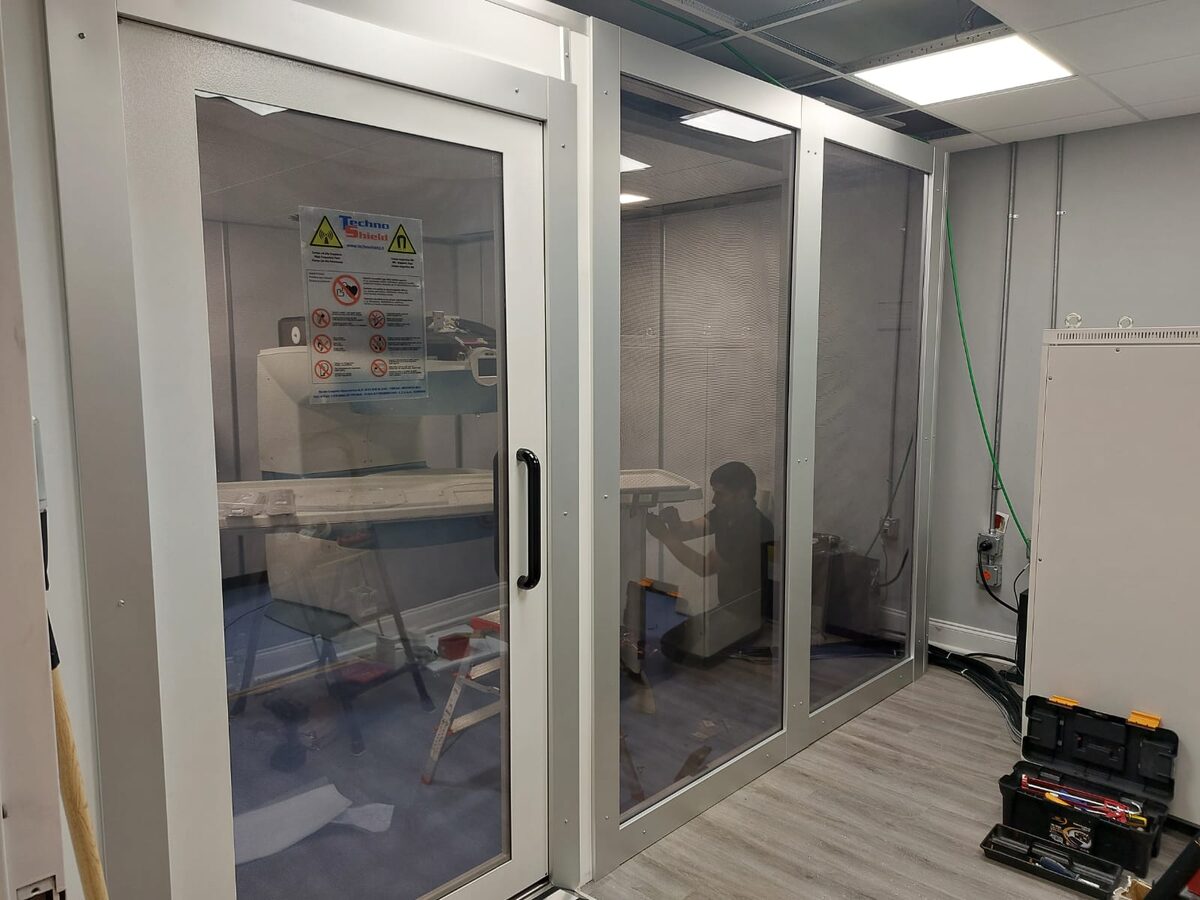
What bore design means for the shielded room
MRI scanners come in different physical configurations. The conventional closed-bore design places the patient inside a cylindrical tunnel; wide-bore variants use the same cylindrical geometry with a larger opening; and open MRI designs replace the tunnel with a vertical gap between two magnet poles. These choices are usually driven by clinical and patient-comfort factors — claustrophobia, patient size, and the type of exam — but they also shape the shielded room around the scanner.
Every one of these designs still requires a complete Faraday cage, because the RF physics does not change with bore shape. What changes is the scanner's footprint, weight, magnet type, and fringe field profile, all of which feed into how the shielded enclosure is sized, laid out, and coordinated with the building. Understanding these differences early helps a facility avoid designing a room that does not suit the scanner it ultimately installs.
Closed-bore and wide-bore superconducting scanners
Closed-bore and wide-bore scanners are almost always superconducting magnets, typically at 1.5T or 3T. They deliver the strongest fields and highest image quality, and they are the most common design in hospitals and imaging centers. From a shielding standpoint, they bring the full set of superconducting requirements: a significant static fringe field that may call for passive magnetic shielding, a quench pipe to vent cryogen safely, and heavy magnet weight that the building structure must support.
Wide-bore versions, with their larger patient opening, tend to be physically larger and can have a slightly different fringe field footprint than a standard closed bore of the same field strength. For high-field systems, the shielding requirements are the most demanding of any bore type. The 3T and ultra-high-field considerations apply directly to these scanners, and the RF enclosure must meet a tight specification to protect image quality.
Open MRI designs
Open MRI scanners use a vertical field geometry with two magnet poles above and below the patient, connected by a C-shaped or pillar frame. Historically many open systems were lower-field permanent or resistive magnets, which produce a smaller static fringe field and often reduce or eliminate the need for passive magnetic shielding. Permanent-magnet open systems also avoid cryogens, so there is no quench pipe to route through the enclosure.
These characteristics can simplify parts of the shielding project, but they do not remove the need for a Faraday cage. Because open systems are frequently lower field, the received signal is weaker and image quality can be especially sensitive to external interference, making a well-sealed RF enclosure and attention to EMI and RFI sources just as important as in a high-field room. The room layout also differs: the open geometry and its patient-access advantages change how the table, the magnet frame, and the surrounding clear space are arranged inside the shielded enclosure.
Room sizing and layout by bore type
Bore design directly affects the dimensions and layout of the shielded room. A wide-bore high-field magnet has a larger physical envelope and a bigger fringe field than a compact open system, which means more clear space, potentially more passive shielding, and more structural loading to accommodate. An open system may fit into a smaller or lower room, but its distinct geometry and patient-access pattern still have to be planned into the enclosure.
In all cases, the manufacturer's site-planning drawings for the specific scanner model are the starting point. They define the magnet footprint, the fringe field plot, the required clearances, and the penetration locations. The shielded enclosure — including the shielded door and any observation window — is then designed around that model, not around a generic assumption about bore type. Matching the room to the actual scanner is what prevents costly redesign later.
Planning around the chosen scanner
The practical lesson is that bore type is one input into the shielding design, not a shortcut that determines it. A facility should choose the scanner based on clinical needs and patient population, then design the shielded room around that specific model's footprint, fringe field, weight, and penetrations. Assuming that an open system needs no magnetic shielding, or that any wide-bore magnet behaves like another, can lead to planning errors.
Bringing the shielding engineer into the project planning and budget alongside the scanner vendor ensures the enclosure is sized correctly from the start. Whatever bore design is chosen, the completed room should undergo shielding effectiveness testing to confirm it meets the manufacturer's specification before the scanner is put into clinical service.
Frequently Asked Questions
Does an open MRI need less shielding than a closed-bore scanner?
Often less magnetic shielding, but not less RF shielding. Many open systems are lower-field permanent or resistive magnets with a smaller fringe field, which can reduce or eliminate passive magnetic shielding and avoid a quench pipe. However, every MRI still needs a complete Faraday cage, and lower-field open systems can be especially sensitive to external RF interference.
Why do wide-bore high-field scanners have the most demanding shielding?
Wide-bore scanners are typically superconducting magnets at 1.5T or 3T, which produce the strongest fields, the largest fringe fields, and require cryogen venting. Their larger physical envelope and heavier weight add structural demands, and the RF enclosure must meet a tight specification to protect the high image quality these systems are chosen for.
Can I design the shielded room before choosing the scanner?
It is risky. Bore type is only one factor; the specific model's footprint, fringe field plot, weight, and penetration locations drive the enclosure design. The best practice is to select the scanner based on clinical needs, then design the shielded room around that model's site-planning drawings to avoid costly redesign later.